
The practical aspects of risk assessment

Scope of Risk Assessment

Our company can provide comprehensive solutions, even for items and complex conditions not covered by explosion-proof guidelines or IEC Ed3.0, by conducting engineering studies in fields such as chemical engineering, thermodynamics, and fluid dynamics.

*The blue text in the "FPEC Compliance Scope" column of the table indicates items for which specific calculation methods are not described in the explosion-proof guidelines or IEC Ed3.0, or for which there are complex conditions.

横スクロールできます
item FPEC coverage explanation
substances that can be evaluated
  • Gases (hydrogen, methane, etc.)
  • Flammable liquids (such as flammable liquids classified as hazardous materials)
  • Liquefied gases (propane, butane, etc.)
  • Cryogenic liquefied gases (LNG, liquid hydrogen, etc.)
  • Multicomponent fluid (a mixture of multiple substances)
  • Fluids containing inert gases, non-volatile liquids, solids, and water (e.g., paints, research samples, etc.)
  • multicomponent fluid
    Estimate the physical properties of the mixture and then evaluate it.
  • When inert gases, non-volatile liquids, solids, or water are included.
    Evaluation considering non-volatile components
  • liquid hydrogen
    Evaluation taking into account special handling conditions such as extremely low temperatures.
emission source
  • Continuous Grade Emission Source
  • First class emitter
  • 2nd class emitter
  • Suitable for all emission levels
    This system can handle not only Grade 2 emission sources, but also continuous grade and Grade 1 emission sources.
  • First class emitter
    There are various cases, and we will consider evaluation methods based on the actual phenomena.
  • *Examples of evaluations are,HerePlease refer to the following.
Outdoor/Indoor
  • Outdoor
  • indoor
  • Indoor evaluation
    Evaluated based on IEC Ed3.0
    (The explosion-proof guidelines have limited coverage regarding indoor environments.)
  • Presentation of ventilation system requirements
    Evaluation considering non-volatile components
Chiiling /
Non-Boiling
liquid
  • If the leaked liquid has reached its boiling point, it may be affected by the heat of the ground, etc. (Boiling liquid)
  • Non-boiling liquid: The leaked liquid has not reached its boiling point and is not affected by heat from the surroundings.
  • Evaluation of Boiling Liquid
    Evaluation by heat balance calculation
  • When the leaked fluid flushes
    Perform a flash calculation.
Supported industries
  • It complies with IEC Ed3.0 and can be used in a wide range of industries.
  • Our track record isMain AchievementsWe introduce it on the page.
  • While IEC Ed3.0 has some exemptions for certain industries, such as mining and the processing and manufacture of explosives, it is possible to comply with regulations for all other industries.

Actual application

01

Cases where it is released in gaseous form

Because it can be easily calculated according to the standard, risk assessment can be carried out without much difficulty.

02

In some cases, the liquid leaks, creating a puddle on the ground that then evaporates.

The calculation method differs depending on the situation, making it a bit complicated.

If the leaked liquid has not reached its boiling point and is not affected by heat from the ground.

The evaporation rate calculation is based on mass transfer calculations due to wind, and the evaporation rate is calculated using the formula described in IEC Ed3.0. The leakage time at this time will be determined based on actual conditions such as on-site patrols, and with reference to APIs, etc.

If the leaked liquid has reached its boiling point, it may be affected by the heat of the ground, etc.

According to the provisions of IEC Ed3.0, the evaporation rate formula described in IEC Ed3.0 cannot be applied under these conditions. Therefore, we determine the evaporation rate from heat balance calculations involving solar heat, atmosphere, and ground.

If the leaked liquid has not reached its boiling point and is not affected by heat from the ground.

Even when flushing, the evaporation rate formula described in IEC Ed3.0 cannot be applied. Therefore, the flushing rate is determined by a flushing calculation, and the evaporation rate from the remaining liquid is calculated separately.
As explained above, it is important to note that the dangerous distance cannot be calculated unless the amount of flash gas and the amount of evaporated gas are calculated separately.

03

Physical properties of leaked material

The physical properties of the substances listed below need to be determined for each temperature, and methods for predicting physical properties must also be utilized.

In the case of a pure component fluid

  • Specific heat at constant pressure, specific heat ratio, density, latent heat of vaporization, vapor pressure, etc., for gases and liquids.
  • Vapor pressure is calculated from Antoine's constant.

In the case of a multi-component fluid

Multi-component fluids are more complex than pure-component fluids because their composition needs to be considered.

  • This includes constant-pressure specific heat, specific heat ratio, compressibility factor, density, latent heat of vaporization, vapor pressure, molecular weight, lower explosion limit, boiling point, and liquid composition of gases and liquids.
  • Vapor pressure is calculated by determining the partial pressure of each component from Antoine's constant, and then applying Raoult's law to find the partial pressure of a multi-component system.
  • The lower limit of explosion is calculated using Le Chatelier's law.
  • When a multi-component fluid contains water (H2O), calculations such as flash calculations and evaporation calculations must include water, but calculations of physical properties such as molecular weight, gas density, lower explosion limit, and release characteristics must exclude water.
04

Leakage area

Regarding leaks from flanges, IEC Ed3.0 specifies a range for the leak port area, but it is necessary to determine an appropriate value that is commensurate with the risk, taking into account factors such as the (operating pressure/rated pressure) ratio.

05

Whether or not the area of the leak opening has increased.

The suggested value for the leak area differs depending on whether or not there is a possibility of the leak area expanding during a leak, but it is determined by considering factors such as the maintenance status, the number of years since the plant was constructed, the operating pressure, and the speed of sound.

06

The ratio of liquid that vaporizes is Ec(%).

The "percentage of liquid vaporization Ec(%)" specified in explosion-proof guidelines is usually calculated by determining the liquid leakage rate and the evaporation gas generation rate according to the leakage phenomenon, and then dividing the gas generation rate by the liquid leakage rate.
Unless Ec is known from literature or experiments, it's important to note that it's not a value that can be set from the beginning.
(Ec(%) is not specified in IEC Ed3.0.)

07

Outdoor ventilation rate

When using measured outdoor ventilation rates, IEC Ed3.0 requires that the wind must be one that blows for at least 951 TP3T throughout the year.
If you use the average wind speed announced by the Japan Meteorological Agency or other sources as the ventilation rate, you should be aware that this may lead to a lenient risk assessment.

08

Danger range

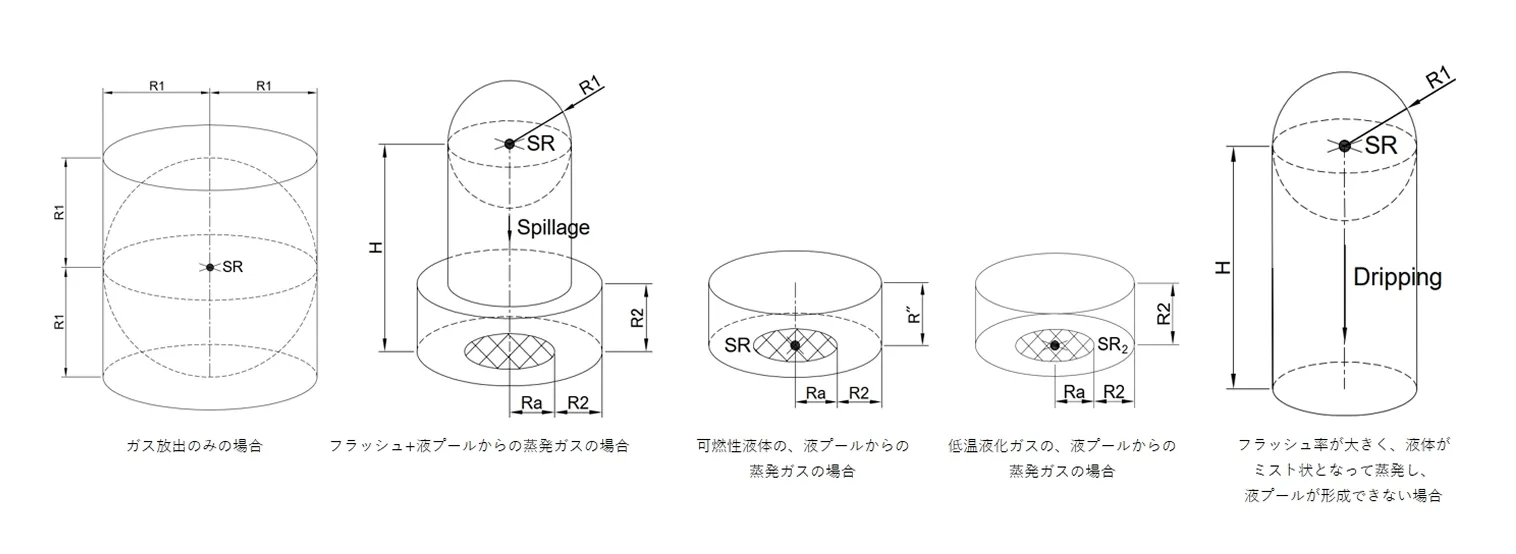
While explosion-proof guidelines do not mention the spatial shape of the hazardous area, IEC Ed3.0 shows it as shown in the diagram below. Based on these, the spatial shape of the hazardous area is determined according to the leakage and evaporation conditions.

危険範囲の空間的な形状(IEC Ed3.0)
09

First class emitter

While the "Explosion Protection Guidelines" primarily cover outdoor, Class 2 emission sources, our company also conducts risk assessments for indoor, Class 1 emission sources based on IEC Ed3.0.
Since there are various cases for Class 1 release sources depending on how the hazardous materials are handled, the gas release rate must be determined on a case-by-case basis. An example of evaluation is shown below.

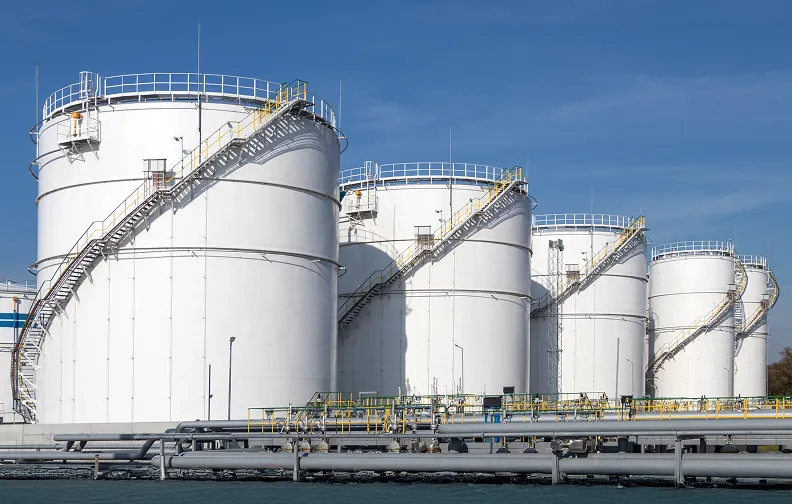
Tank vent

Estimation of gas release rate due to gas phase spatial expansion

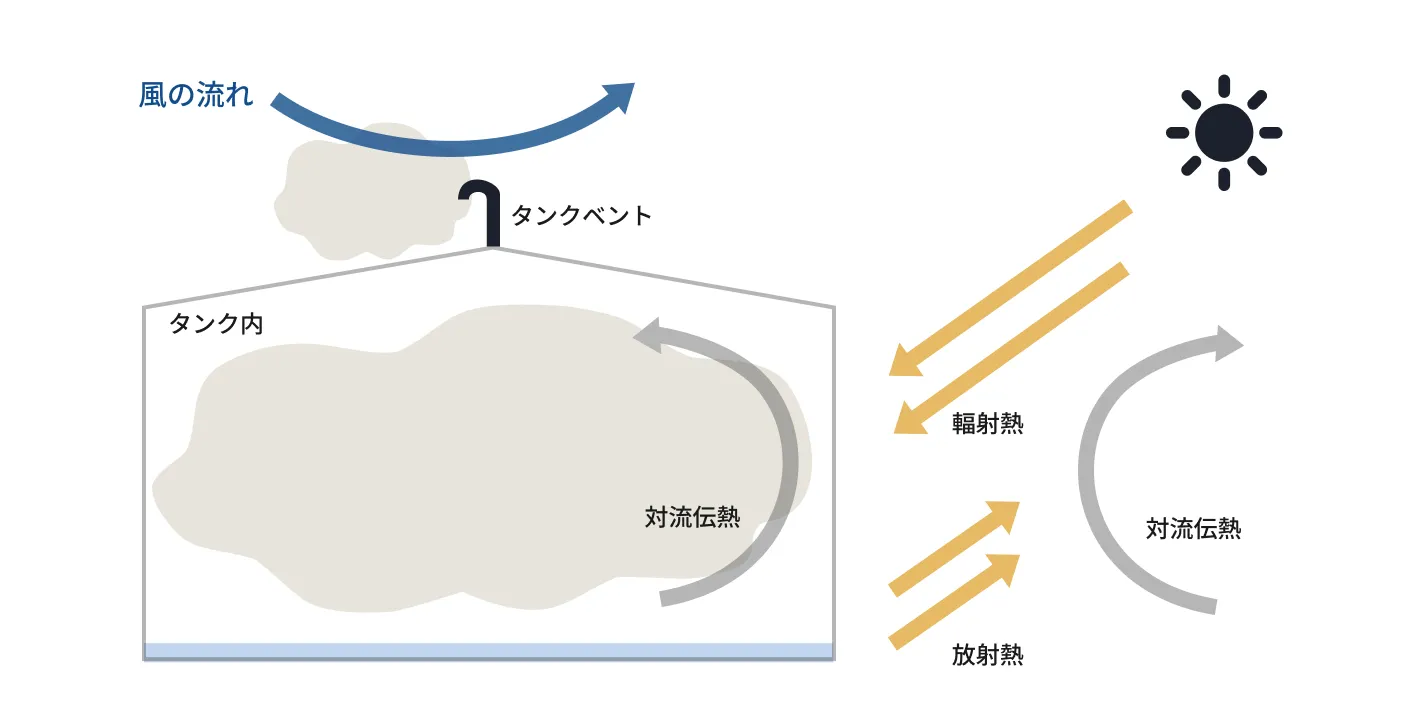
We assume that the tank is almost empty, with its maximum internal volume, and that the small amount of liquid remaining is in vapor-liquid equilibrium at that temperature. We calculate the heat inflow and outflow from the tank, including solar radiation, radiant heat, and convective heat transfer due to wind, to the tank's roof and side walls. We then determine the rate of temperature rise in the gas phase inside the tank and calculate the release rate of the vent gas from the volume expansion rate of the gas phase.
Since the amount of radiant heat from the sun is determined by the latitude and longitude of the installation location, the date, and the sun's altitude at that time, it is possible to understand the changes in the hazardous area over time by determining the change in the gas emission rate over time.

気相空間膨張によるガス放出速度の推定のイメージ
Example of calculation for the release rate of vent gas from a kerosene tank (15,000 m³) (gas phase spatial expansion case) (Click to enlarge)
灯油タンク(15000m3)ベントガスの放出速度計算例(気相空間膨張ケース)
Estimation of boiling evaporation rate based on tank sidewall temperature

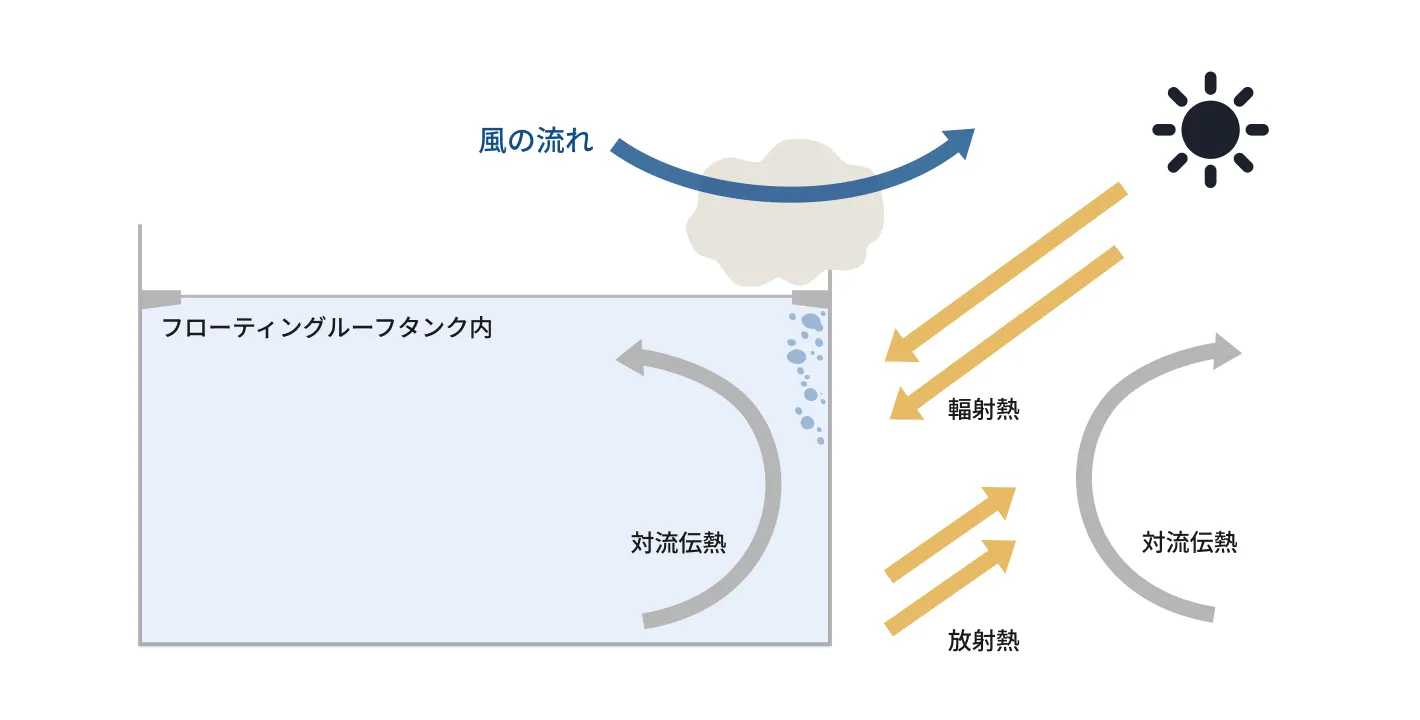
When the tank is full, we calculate the amount of heat passing through the tank's side walls and assume that the internal liquid is heated by this heat. When the temperature of the tank's side walls is below the boiling point, the heat input is used to raise the overall liquid temperature, and when the temperature of the tank's side walls reaches the boiling point, all the heat input is used for the evaporation of the liquid, and we then determine the gas release rate.
In the case of a floating roof tank, since there is almost no space volume in the gas phase, we consider boiling evaporation rather than gas phase expansion.
Similarly, by determining the time-dependent changes in the sun's altitude, we can understand the time-dependent changes in the danger zone.

タンク側壁温度による沸騰蒸発速度の推定のイメージ
Example of calculation for the release rate of vent gas from a kerosene tank (15,000 m³) (gas phase spatial expansion case) (Click to enlarge)
灯油タンク(15000m3)ベントガスの放出速度計算例(気相空間膨張ケース)

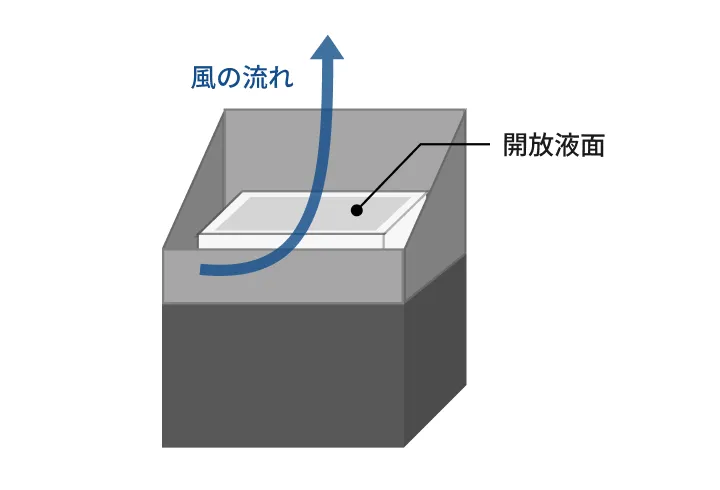
Evaporation from the liquid surface when open to the atmosphere

When evaporation occurs from a liquid surface exposed to the atmosphere, the gas generation rate is determined by mass transfer calculations or heat balance calculations, after confirming factors such as how the liquid is handled and whether there is wind above the liquid surface (for example, if the liquid surface is deep in the container, wind may not blow easily).

大気開放の液面からの蒸発 図解

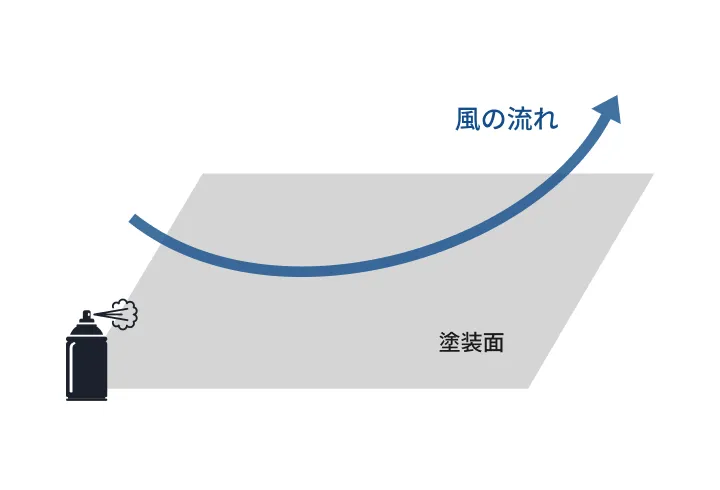
Evaporation from painted surfaces

We will consider a scenario where the paint is applied uniformly to the entire painted surface at once and evaporates from the entire surface. This represents the maximum gas generation rate and will be considered as a conservative risk assessment.

塗装面からの蒸発 図解

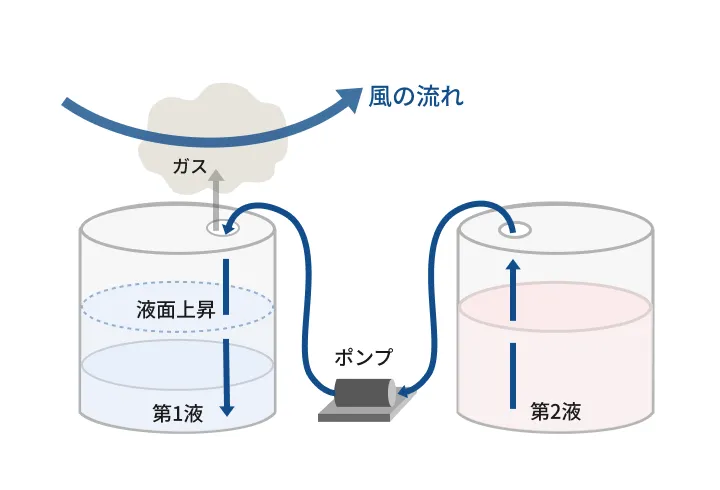
Liquid mixing in an open container

Let's consider a scenario where an open container holds the most volatile liquid (liquid 1), and another liquid (liquid 2) is added to it. The gas generated from liquid 1 is then pushed out of the open container by the volume of liquid 2 and released.
The release rate is determined from the gas concentration generated from the first liquid, the volume of the second liquid added, and the addition time.

開放容器での液混合 図解
10

2nd class emitter

Class 2 emissions are rare sources that occur during normal operation, and basically the following fittings as specified in explosion-proof guidelines and IEC Ed3.0 are covered.

  • Flange equipped with a compression fiber gasket or similar.
  • Flange equipped with a helical gasket or similar.
  • Ring-type joint connection (O-ring, etc.)
  • Small diameter connection part 50mm or less (screw connection, etc.)
  • Valve stem packing
  • Pressure release valves (vents, drain valves, etc.)
  • Pump and compressor shaft seal section

Furthermore, depending on the working conditions at the hazardous materials facility, we will consider leaks caused by human error. For example, there are cases where hazardous materials containers (drums, 18-liter cans, etc.) being transported to the manufacturing site are accidentally tipped over, leading to leaks. In this case, we assume that the entire contents of the container leak out at once, and that evaporation occurs from the spread liquid surface.
Large leaks often result in the area being classified as a hazardous zone. However, if you wish to change this classification to a non-hazardous zone, you must clearly state in your voluntary action plan measures such as preventing containers from tipping over and changing to smaller packaging sizes, thereby declaring that you will take steps to make the area a non-hazardous zone.
The voluntary action plan is submitted to the local fire department and approved upon its submission. Therefore, the measures outlined in the plan become a commitment and must be followed just like any law.

11

Risk assessment results

In any case, as required by IEC Ed3.0, it is important to show the basis for the figures determined in the risk assessment. At our company, we summarize the risk assessment results along with physical property data for each case under consideration, as shown in the table below, and clearly record the details of the risk assessment.
We can also handle risk assessments for overseas locations, and we can provide assessment results in English.

Risk assessment results
リスク評価結果 図解(拡大)
Physical property data
物性データ 図解(拡大)