
radiant heat(Tank fire / Leakage fire)

About radiant heat simulation

Our company has focused on "leakage of hazardous materials," which is the primary initial event in disasters at chemical plants and similar facilities, and has developed a simulation program that analyzes a series of phenomena, from the spread of leaked liquid to evaporation and gas diffusion.

Types of calculation methods

There are various methods for calculating radiant heat, as shown in the table below, and our program can perform calculations using any of these methods. However, we recommend the "Mudan method" described in the NFPA Handbook as the most practical method.

In methods other than NISTIR6546, the radiant exitance is taken as the average value over the entire flame height.
The actual state of the flame is that the lower part near the oil surface burns brightly, while above it is mostly smoke with occasional flickers of red flame. NISTIR6546 calls this bright area the Luminous Band, and assumes that its radiant dispersibility is approximately 100 [kW/m2] regardless of the type of oil, and provides a formula for calculating the height of that area.
While the radiation intensity at points several times the tank diameter can be measured using the mean radiation exitance method, the luminous band concept seems more practical for areas closer to the tank.

横スクロールできます
item Industrial complex
Safety and disaster prevention technical guidelines
KHK-E007-1974
petrochemical complex
Disaster Prevention Assessment Guidelines
(Fire and Disaster Management Agency Special Disaster Office)
NISTIR6546
(National Institute of Standards and Technology, USA)
Mudan method
(NFPA Handbook)
Wind conditions Only under windless conditions Only under windless conditions Calm and windy Calm and windy
heat receiving surface Vertical surfaces only Vertical surfaces only You can select the "maximum heat-receiving surface angle" and either "vertical" or "horizontal". You can select the "maximum heat-receiving surface angle" and either "vertical" or "horizontal".
Height of the flames 1.5D 1.5D The height of the luminous band is calculated from the tank diameter and the physical properties of the fuel. Calculated from the tank diameter and the physical properties of the fuel (using a different formula than NIST)
Radiation divergence "Actual measured values of the target fuel" or "Calculation formula specified in the guidelines" "Measured values of the target fuel"
Furthermore, it is stipulated that the radiant extinction should be multiplied by a "reduction rate" (a reduction rate of 0.3 is used in the program because the calculated value deviates significantly from the actual value).
"Constant" regardless of fuel "Measured values of the target fuel" or "Calculated using a method specific to the Mudan method"
Features Because the flame height is kept constant by the ratio of the diameter, when the tank diameter increases, the flame height is overestimated, resulting in a higher radiant heat calculation result than the actual value. Aside from the concept of reduction rates, it is the same as the "Technical Guidelines for Safety and Disaster Prevention in Industrial Complexes KHK-E007-1974".
This results in an underestimation of radiant heat, making it appear safe everywhere.
A reasonable result can be obtained regarding the radiant heat near the burning tank during firefighting operations. It's practical because you can input the radiative exitance, and the calculation results will differ depending on the physical properties of the fuel.

Calculation results (radiant intensity by each method)

The results of calculations using each method for fire cases involving gasoline tanks and heavy fuel oil tanks with a diameter of 82m are shown in the figure below.
The horizontal axis represents the distance from the center of the tank as a multiple of the tank diameter.

直径82mガソリンタンク輻射熱計算結果グラフ(拡大)
直径82mA重油タンク輻射熱計算結果グラフ(拡大)
Use the 3D viewer to make simulation results more "realistic".

By using the dedicated "FM Viewer," you can freely manipulate the simulation results on your PC. You can pinpoint and zoom in on the area you want to see, dramatically improving your understanding of the analysis accuracy compared to conventional still images.

Services offered: Tank fire extinguishing / Radiant heat calculation / Water and foam discharge

Further details are explained on the FM Viewer introduction page.

FM Viewer

Radiant heat simulationExamples

01

Tank fire

Case of a 72-meter diameter crude oil tank fire

The heat-receiving surface is set to the maximum heat-receiving surface angle. Of course, the radiation intensity of horizontal or vertical heat-receiving surfaces is also possible. The figure on the right shows the radiation intensity map at two heat-receiving surface heights. The radiation intensity can be output in either "kcal/m2/h" or "kW/m2".

1.5m above ground level

直径72mタンク火災 地上高さ1.5mにおける輻射強度

Heights of 1.5m and 22m above ground

直径72mタンク火災 地上高さ1.5mおよび22mにおける輻射強度
02

Process area fire

Case of an oil spill pool fire

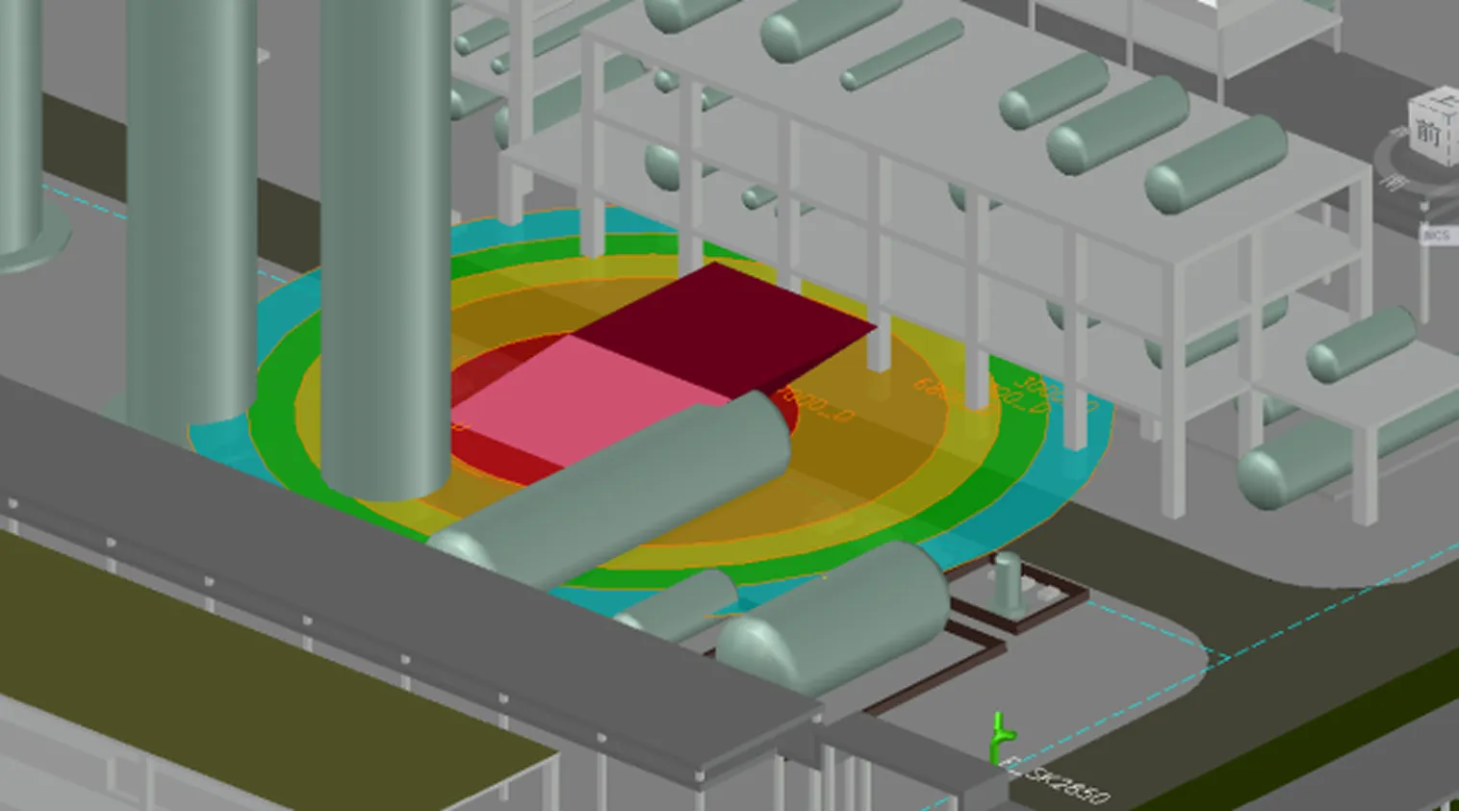
The diagram below shows a radiant heat map of a 10m x 10m diesel fuel pool created on the concrete floor of the process area and then caught fire.
The oil spill pool can be placed anywhere and in any size. Since the height of the heat receiving surface can also be freely adjusted, it is possible to identify equipment receiving strong radiant heat and confirm the need for cooling water spraying.

プロセスエリア漏油プール火災の輻射熱計算結果
03

3D radiation intensity

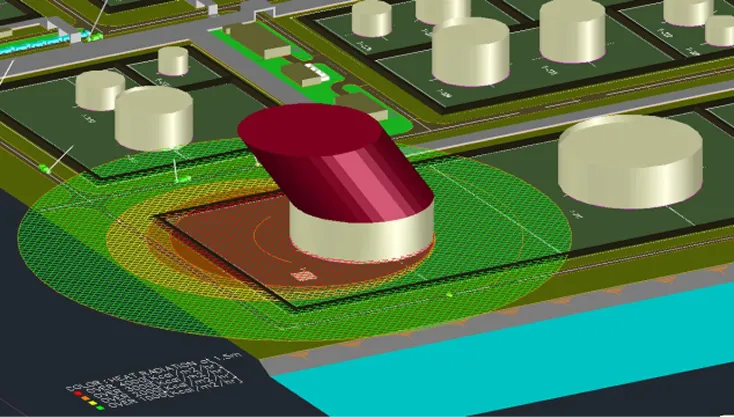
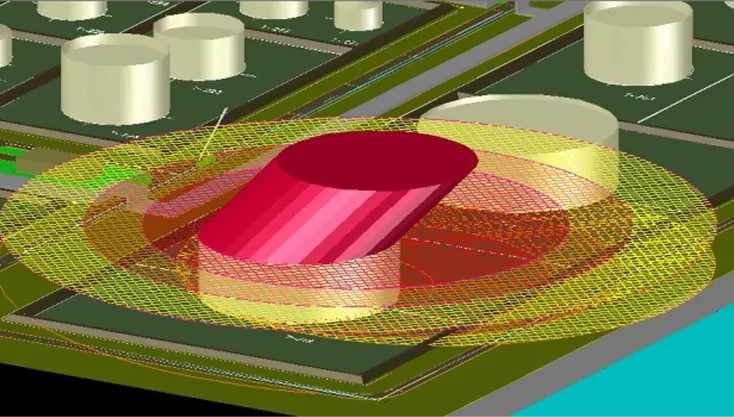
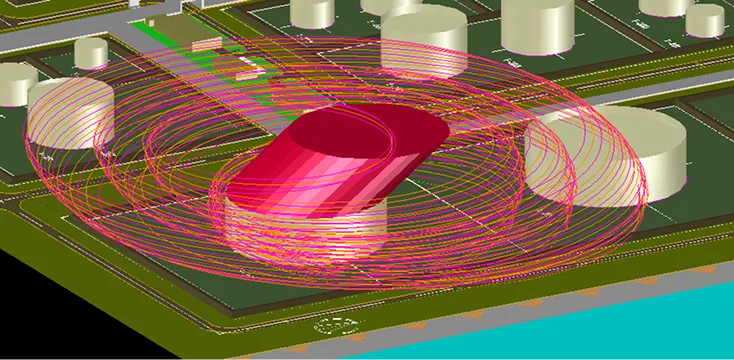
A case of a tank fire where the flames are tilted due to the wind.

Our radiant heat simulation program can generate concentric circles with the same level of radiant intensity by precisely varying the height of the heat-receiving surface, not just at two arbitrary heights.
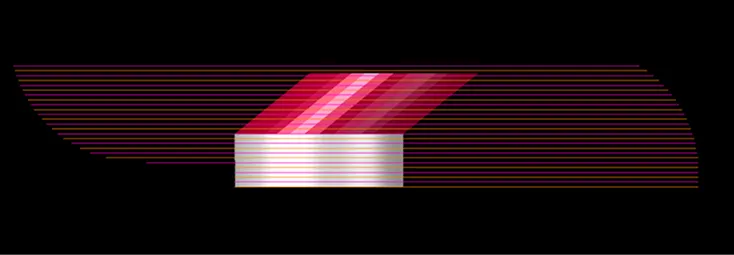
The lower left diagram shows a tank fire where the flames are tilted due to wind. Downwind, the radiation intensity is higher near the ground, but the heat intensity at higher positions than the tank is actually greater upwind. The upper part of the tank upwind receives unexpectedly strong radiant heat, and the flammable gases evaporated there can flow to the fire downwind, posing a risk of ignition and fire spread. We recommend considering the need to cool the upwind tank with water spraying. The lower right diagram shows the same situation viewed from the side.

Simulation results

風の影響によるタンク火災三次元輻射強度シミュレーション結果

A side view of the diagram on the left.

風の影響によるタンク火災三次元輻射強度 横からの図