
When the main valve is opened, gas flows through the empty piping, expanding as it reaches the nozzle, undergoing changes in pressure and temperature, and finally being released into the atmosphere as a stable jet, where it diffuses. The series of calculations up to the point of reaching the nozzle involves determining the jet velocity, temperature, and density using a thermodynamic/engineering approach, and then performing diffusion calculations using numerical analysis methods based on that data. In most cases, the jet velocity is greater than the speed of sound, so the ejection velocity has a significant impact on diffusion.
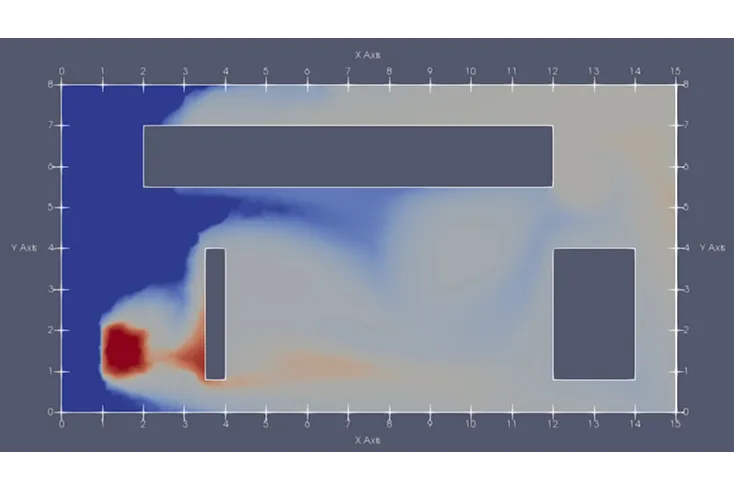
The gradient density map is a result diagram obtained from numerical analysis.
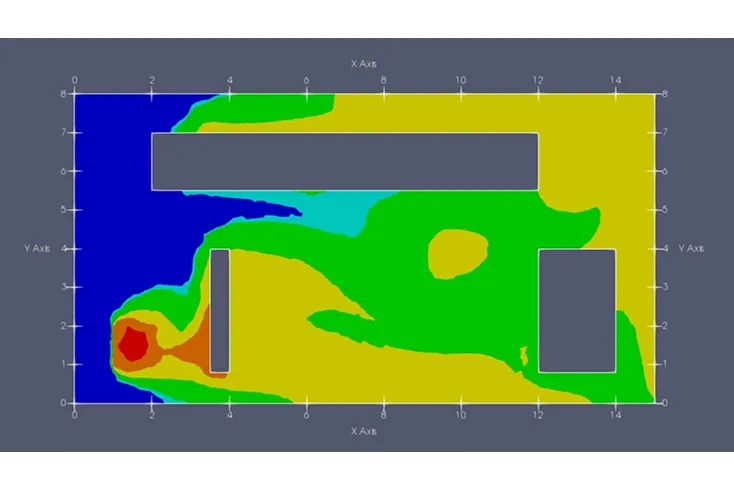
On the other hand, our company creates contour plots (isoline plots: points with the same value are connected by lines, and the areas between them are color-coded) based on the calculation results obtained from numerical analysis. Compared to gradient density maps, the boundaries and ranges of density are extremely clear, and we believe that this is very effective for subsequent analysis and consideration.
Example of individual risk assessment results
Examples of individual risk assessment results and physical property data