explosion
(BLEVE, Fireball, VCE, Flash Fire)

About explosion simulations

Hazardous materials facilities such as petrochemical plants pose serious disaster risks, including gas dispersion, fire, and explosion. While explosions can be classified into several types depending on their cause and circumstances, our program covers all of them, enabling optimal simulations for each type.

While there are various methods for explosion simulation, our program primarily employs the method based on the "Guidelines for Disaster Prevention Assessment of Petrochemical Complexes (hereinafter referred to as the 'Combination Guidelines')" as the most practical approach.
Please note that our program primarily targets open outdoor spaces; indoor explosion events are simulated using numerical analysis methods (such as CFD).

Explosion classification

01

BLEVE (Boiling Liquid Expanding Vapor Explosion)

This is called a brevi, and is translated as a boiling liquid expansion vapor explosion or boiling liquid vapor diffusion explosion. It is an explosive phenomenon caused by the rapid boiling of a liquid and is triggered by the rupture of the container.

02

Fireball

This phenomenon occurs when flammable vapors released into the atmosphere by BLEVEs or similar devices rapidly ignite while suspended in the air, forming a fireball that generates a very large amount of radiant heat.

03

Vapor Cloud Explosion (VCE)

An outdoor gas cloud explosion that generates enough explosive pressure to cause damage.

04

Flash Fire

An explosive combustion that does not generate explosive pressure. A disaster in which a range of flammable gases with concentrations above the lower explosive limit rapidly ignites when they reach an ignition source.

Features of Flashfire

  • A flashfire does not generate pressure waves. Therefore, no destruction occurs due to impact.
  • The scope of the impact is limited to areas where the gas concentration is within the explosive limits. This hazard exists only within the concentration area within the explosive limits.
  • It's extremely dangerous because you're engulfed in the flame itself, rather than just radiant heat. Since the burning time is said to be less than one second, radiant heat doesn't need to be considered.

Points to note during implementation

One point to keep in mind when conducting explosion simulations is that explosions don't happen suddenly; rather, there's a sequence of events leading up to them, such as the leakage of hazardous materials, gas dispersion, and in some cases, a flash fire followed by a containment dike fire, and then a BLEVE (Burst-Liquid Emission Velocity) event.
The pressure wave caused by BLEVE increases with the size of the container's internal volume. However, before BLEVE occurs, the safety valve ejects due to the pressure rise in the container, increasing the amount of liquid leakage and further increasing the internal volume. It is necessary to calculate these changes over time and reflect them in the simulation.

Our company conducts comprehensive disaster simulations covering the entire process, from initial events such as leaks and evaporation to gas diffusion, fire, and explosion, and assesses the overall impact.

The sequence of events leading up to BLEVE

BLEVEに至る災害の流れ

catalog

You can download the explosion simulation catalog from here.

爆発シミュレーション カタログ表紙

BLEVE

Calculation method

Based on the Combo guidelines, the released energy is calculated from the pressure difference before and after container rupture using "Blode's formula" or "Crowl's formula," and the reach of the pressure wave is calculated based on the TNT equivalent.

The distance traveled by debris (flying fragments) from a container rupture is proportional to the power of the amount of liquid remaining in the container at the time of the BLEVE, and is calculated using a simplified formula from AiChE (American Institute of Chemical Engineers).
It should be noted that BLEVE (Blood Loss of Energy) does not only occur with flammable liquids such as LPG, but can also occur in the rupture of liquid storage containers for carbon dioxide, for example.

Accident examples

Please refer to the Combination Guidelines, which contain detailed information on disaster cases that occurred during the Great East Japan Earthquake.
There have been numerous accident reports from overseas, and here we will introduce two of them.

01

Haltern, Germany, September 2, 1976

A railway tanker (CO2, 231 tons, 90% full), with a CO2 pressure of 7 barg and a temperature of -15°C, was traveling at 16 km/h at a track switching point when white smoke was emitted from the safety valve. An explosion then occurred 15 meters away from another train. The fragments amounted to 22 pieces (equivalent to 80% of the total volume) and were blown in two directions over a distance of 360 meters. The cause was attributed to the tank's fragility.

02 San Juan Ixhuatepec, Mexico City, 1984/11/19

LPG spherical tank 1,600 m3x4, 2,400m3There were 2 units of each, totaling 48 bullets measuring 13-32m in length and 2-3.5m in diameter, covering a total area of 11,000-12,000m at the time of the accident.3LPG was stored there. It was a major accident that killed approximately 500 people, injured approximately 7,000, and almost completely destroyed the surrounding area. For some reason, the LNG leaked and spread beyond the 3-foot containment dam, and by the time it reached the flare pit, it had formed a vapor cloud about 2 meters high.
At 5:45 AM, ignition occurred, causing a flash fire. Several buildings into which the gas had entered exploded. One minute after the flash fire, a massive explosion occurred, generating a fireball and sending one or two bullets flying. The fire and the collision of debris caused a series of BLEVEs, including a 1,600m³ LPG spherical tank.3The four units were completely destroyed, but 2,400m3Two of the tanks were almost undamaged, with only their legs buckling. The 12 Bullets flew over 100m, and one even flew an astonishing 1,200m. Only four Bullets remained in their original positions. A residential area about 300m away suffered extensive damage and many casualties. There were 10 to 20 fragments of the spherical tank, while the Bullets were torn in two.

BLEVE Simulation Example

A case in which butane leaked from a spherical tank into the containment dike for 10 minutes.

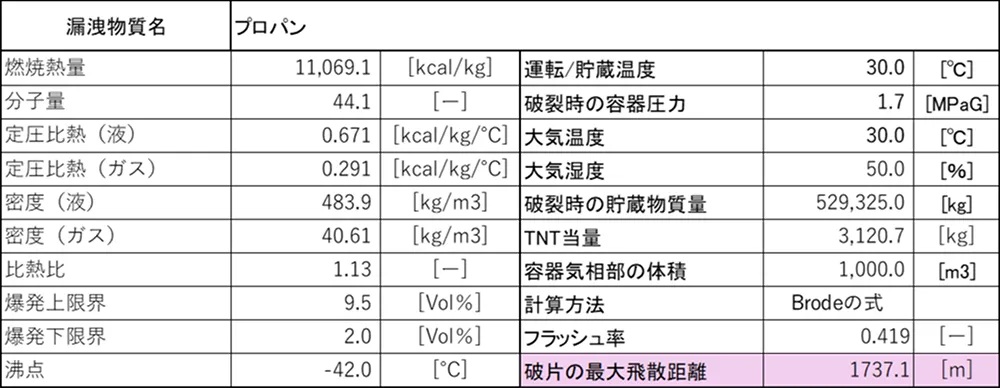
Input values and calculated values

This document summarizes the input values used in the simulation and the calculated values obtained.

BLEVEシミュレーション 入力値および計算値
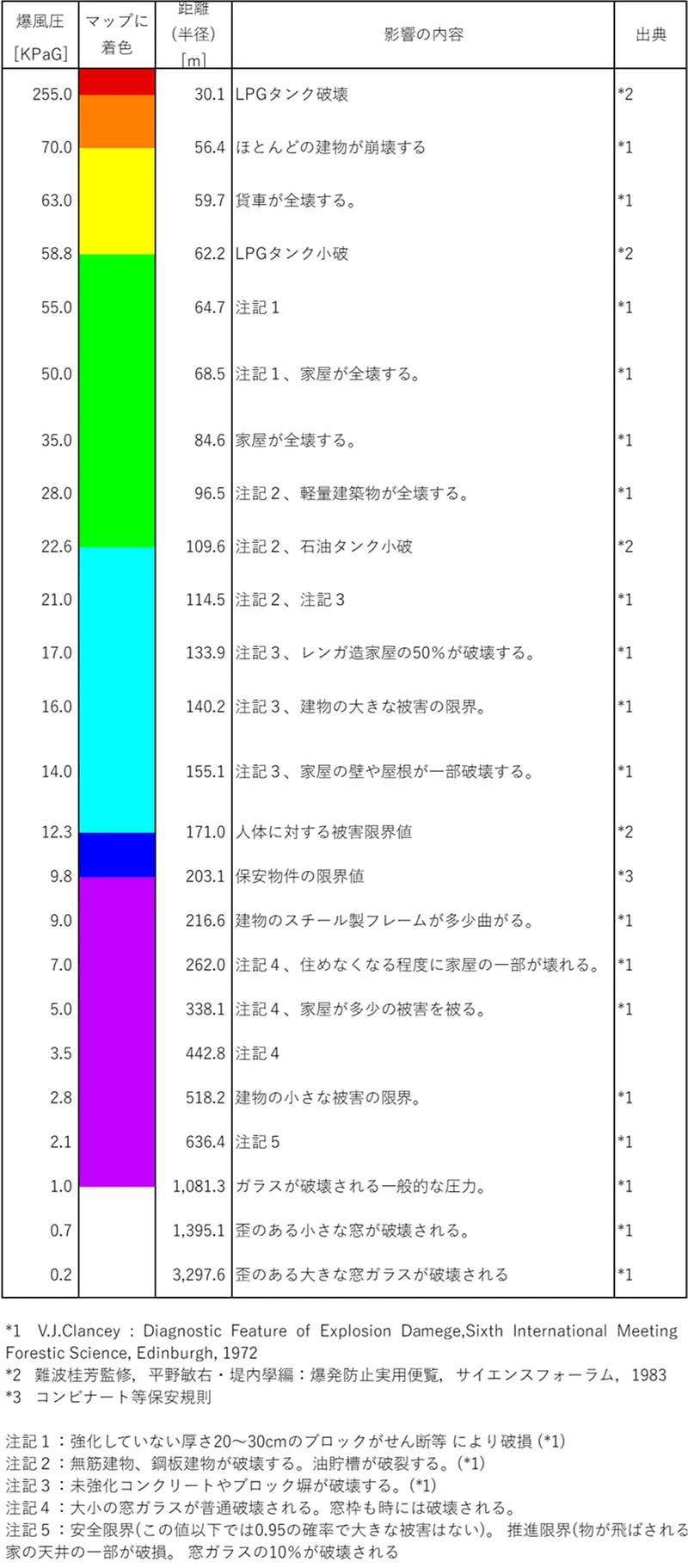
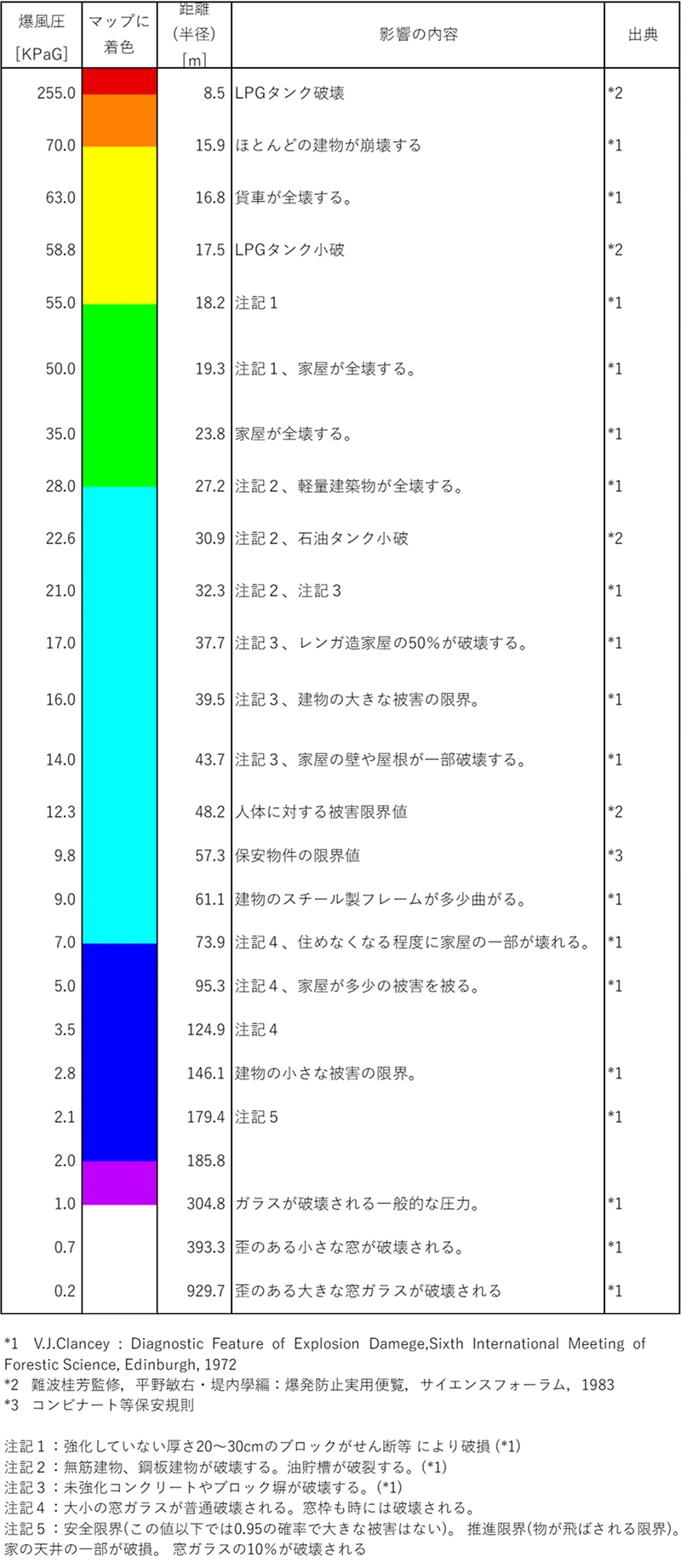
The effects and range of blast pressure

The table below summarizes the "effects of blast pressure" as shown in various documents such as the Combo Guidelines, and the "range of blast pressure" calculated through simulations.
The colors in the "Color Map" section match the display colors in the attached "Blast Pressure Impact Area Diagram."

BLEVEシミュレーション 爆風圧の及ぼす影響と到達距離
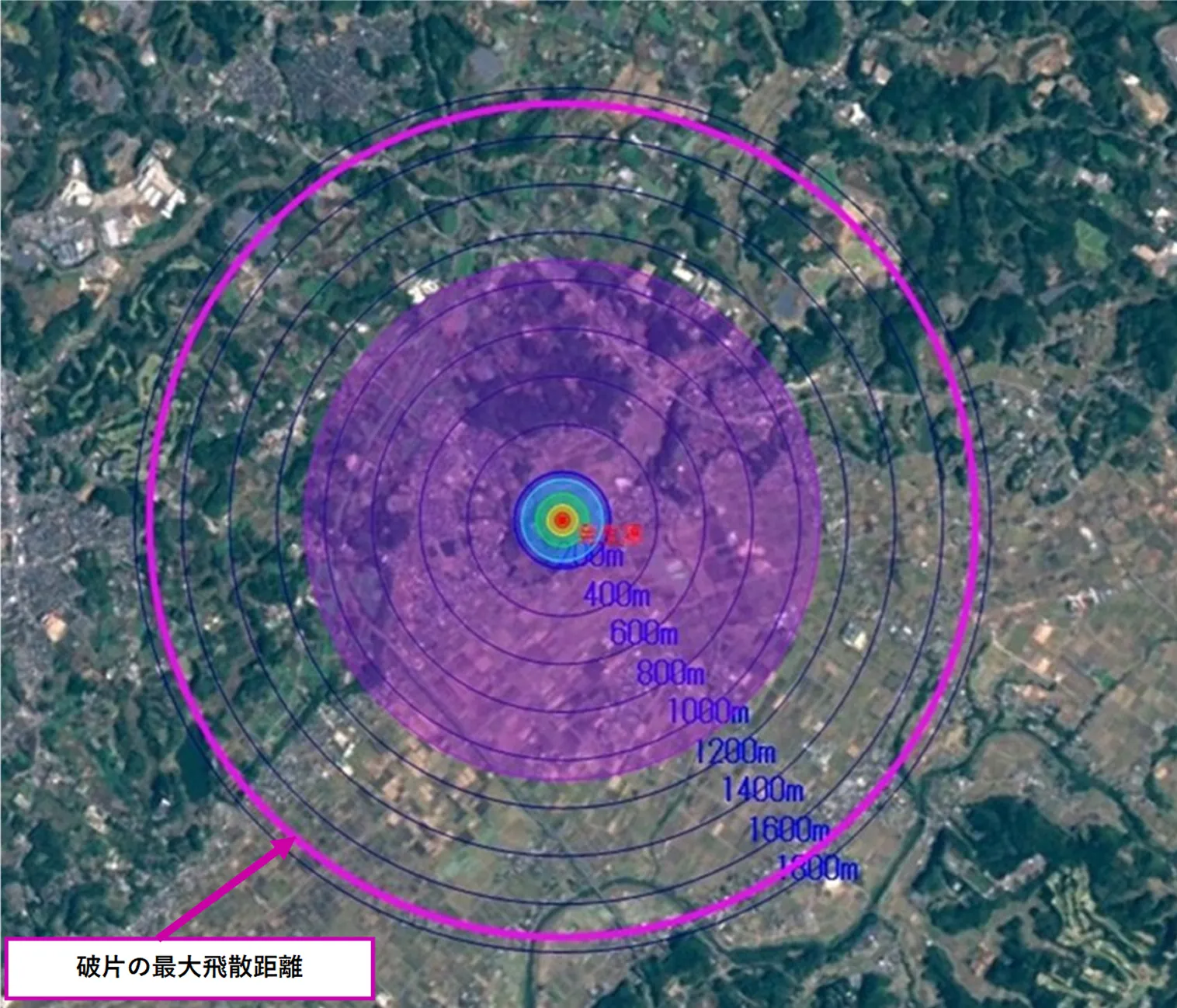
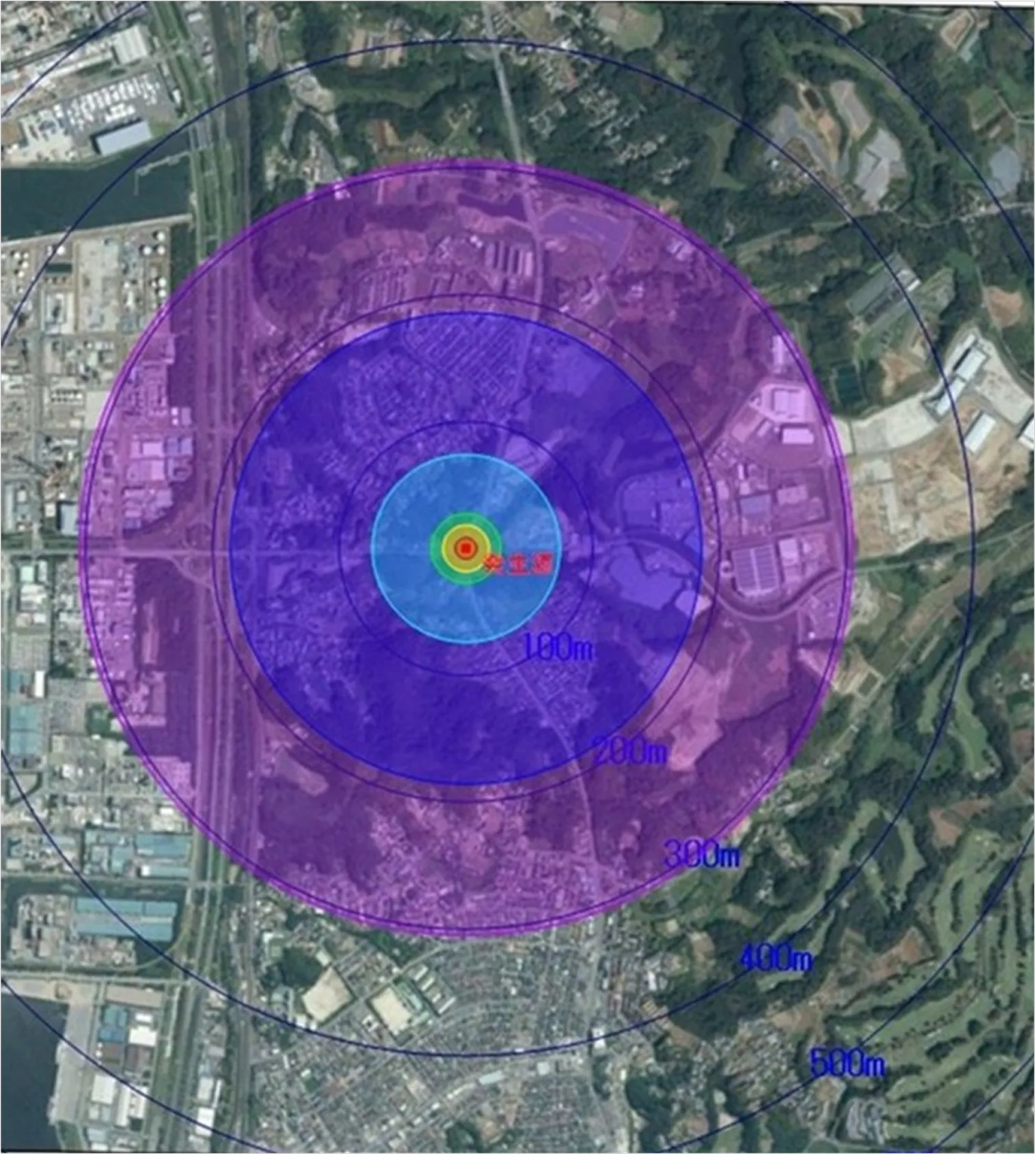
Blast pressure effect area diagram

This map illustrates the area affected by blast pressure. The color coding of the affected area corresponds to the colored areas shown in "Effects and Reach of Blast Pressure."
BLEVE also illustrates the "maximum distance fragments will scatter."

BLEVEシミュレーション 爆風圧の影響範囲図

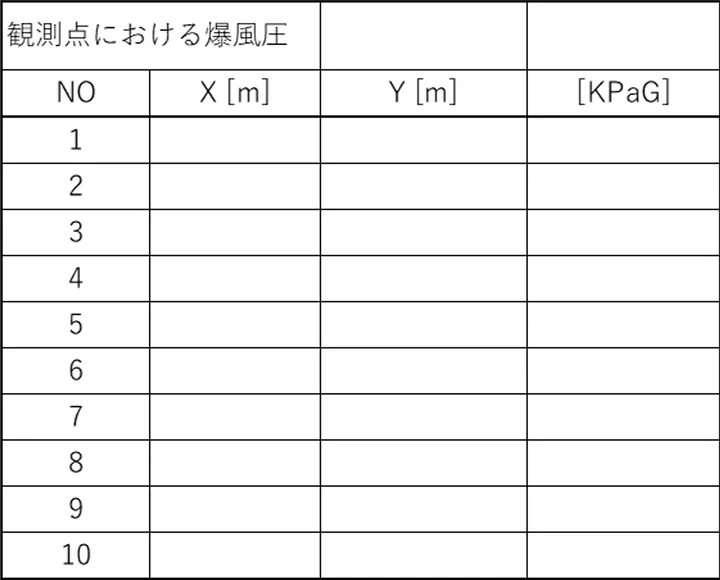
Blast pressure at the observation point

You can specify a location and calculate the blast pressure at that point. (A form for calculating the results is shown here.)

BLEVEシミュレーション 観測点における爆風圧

Fireball

Calculation method

Based on the Combo guidelines, the diameter, center height, duration, and radiant intensity of the fireball are calculated. The size of the fireball increases with the amount of gas, but the amount of gas contributing to fireball generation is considered to be three times the amount of gas that flashes when the container ruptures.
The diameter, center height, duration, and radiant heat of the fireball are calculated using one of the following methods:

How to calculate the diameter, center height, and duration of a fireball

  • A method using the sum of fuel and theoretical oxygen amount, W (kg), as the amount of combustion gas.
  • AIChE method

Method for calculating radiant heat

  • A method for calculating radiant heat for a heat-receiving surface directly facing the center of a sphere.
    The flame temperature is assumed to be 1750 °K. Because a relatively high flame temperature is used, a larger radiation intensity is calculated.
  • AIChE method
    The formula is independent of the fireball's temperature, so differences will occur depending on the material. Furthermore, the calculation incorporates the change in transmittance due to atmospheric humidity, so smaller radiant heat is calculated when humidity is high and the distance is long.

Accident examples

Please refer to the Combo Guidelines for details on disaster cases that occurred during the Great East Japan Earthquake. There are numerous reports of accidents overseas, one of which is the explosion in San Juan Ixhuatepec, Mexico City, on November 19, 1984, which was introduced in BLEVE. Here, we will introduce yet another case.

01 Texas City, Texas, USA 5/30/1978

The accident occurred in the spherical tank area of the refinery (3 spherical tanks, 5 Bullets, and 4 vertical drums). 7 people died, 10 were injured, and the refinery was almost completely destroyed.

2:00 AM
During the injection of isobutane into a spherical tank, a malfunction in the liquid level gauge caused leakage from the top. As a result, a crack formed in a faulty weld, leading to the leak. The point of ignition is unknown, but a flash fire occurred, and 30-60 seconds later, the spherical tank exploded into three large fragments, one of which flew 80 meters. Approximately 800 meters3A fireball was generated by isobutane, followed immediately by the explosion of 5 or 6 bullets and drums, scattering projectiles in various directions. The furthest projectile traveled approximately 135 meters.

AM2:20
Another spherical tank exploded, creating a fireball. The top of the spherical tank flew off, destroying a fire pump and fire water tank 190 meters away. Other fragments further damaged the refinery equipment. Its safety valve flew 500 meters. This second explosion caused more damage than the first. Smaller explosions continued until 6:00 AM, but no large explosions occurred.

Fireball Simulation Example

A case where a BLEVE occurred in a propane spherical tank, immediately followed by a fireball.

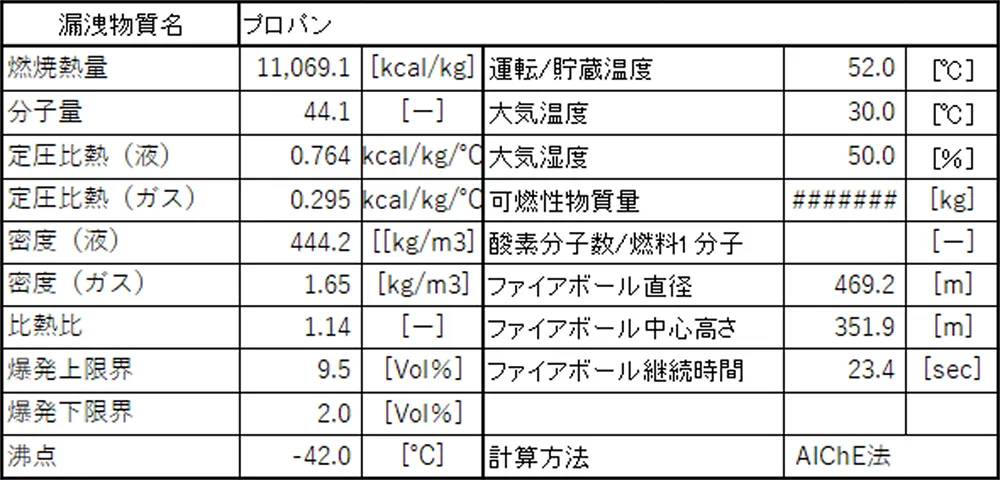
Input values and calculated values

This document summarizes the input values used in the simulation and the calculated values obtained.

ファイアボールシミュレーション 入力値および計算値
The effects and reach of radiant heat

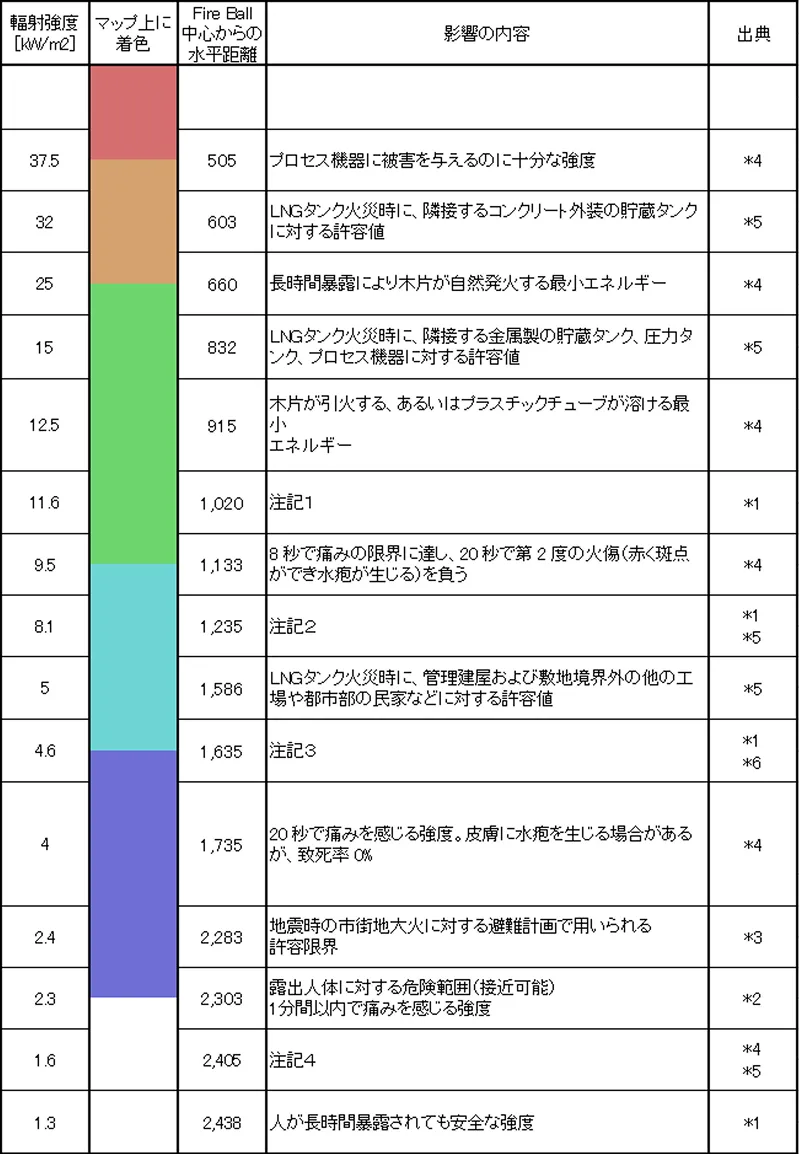
The table below summarizes the "effects of radiant heat" as shown in various documents such as the Combi Guidelines, and the "radiant heat reach distance (horizontal distance from the center of the fireball)" calculated by simulation.
The colors in the "Color on Map" section match the display colors in the attached "Radiant Heat Influence Area Diagram."

ファイアボールシミュレーション 輻射熱の及ぼす影響と到達距離

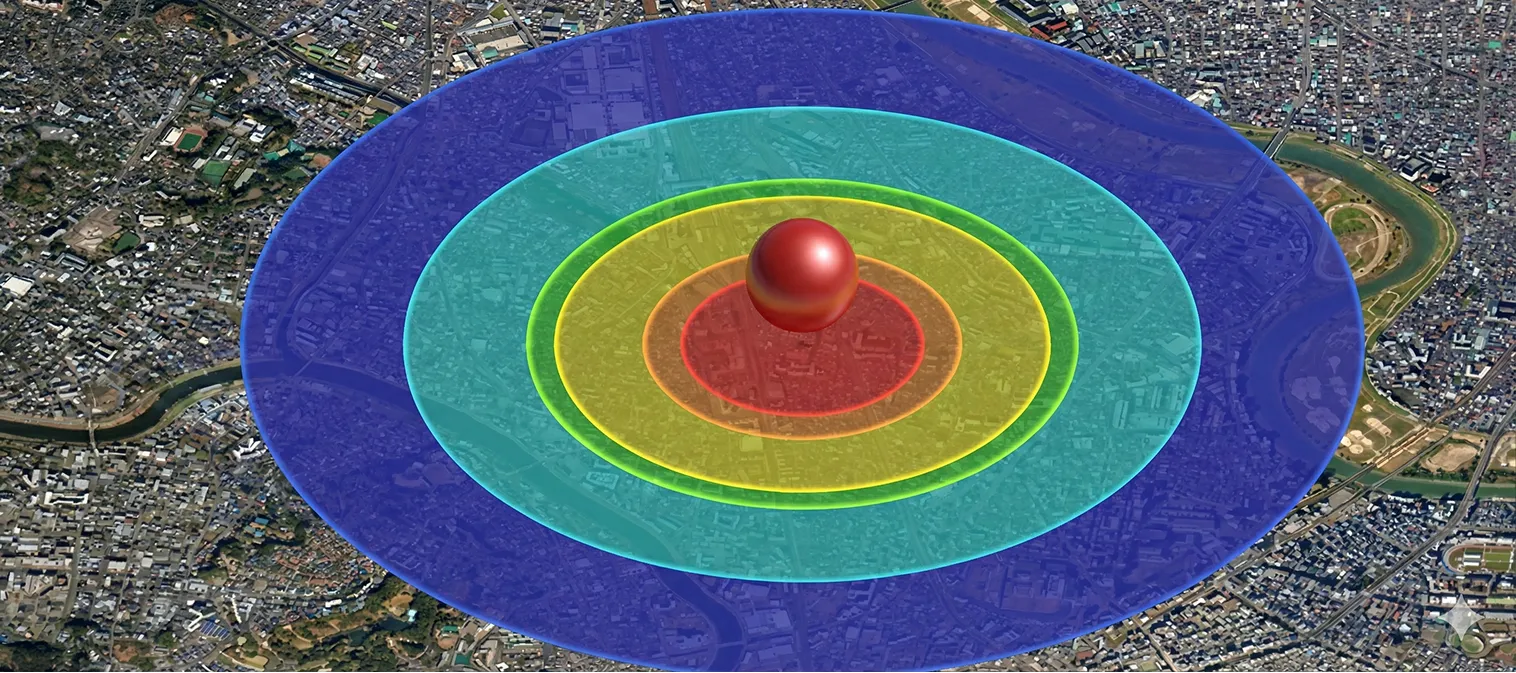
Diagram showing the extent of radiant heat influence.

This map illustrates the area affected by radiant heat. The color coding of the affected area corresponds to the colored areas shown in "Effects and Reach of Radiant Heat." The image below is a 3D map, but it can also be represented as a 2D map.

ファイアボールシミュレーション 輻射熱の影響範囲図
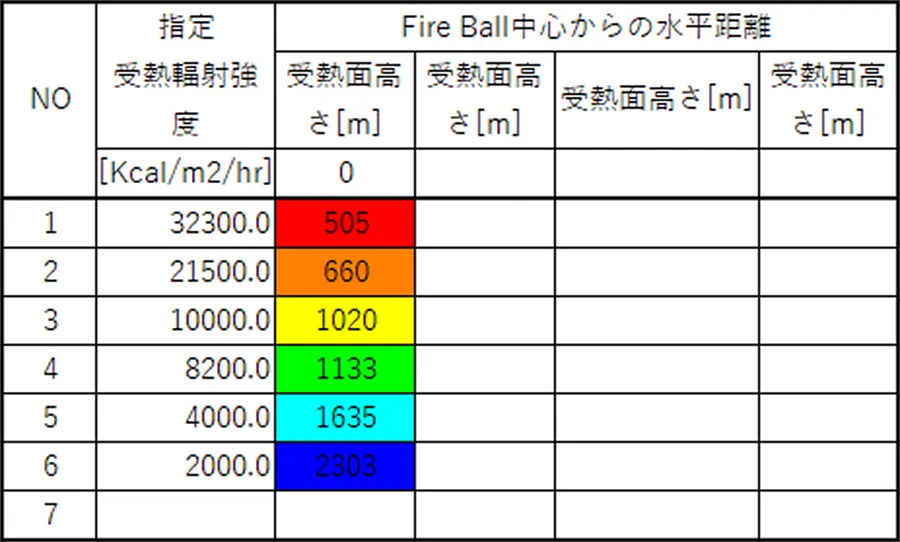
Heat receiving intensity and reach distance

This table summarizes the reach distance (horizontal distance from the center of the fireball) corresponding to a specified radiation intensity. The corresponding display color on the affected area diagram is also shown.

ファイアボールシミュレーション 受熱強度と到達距離
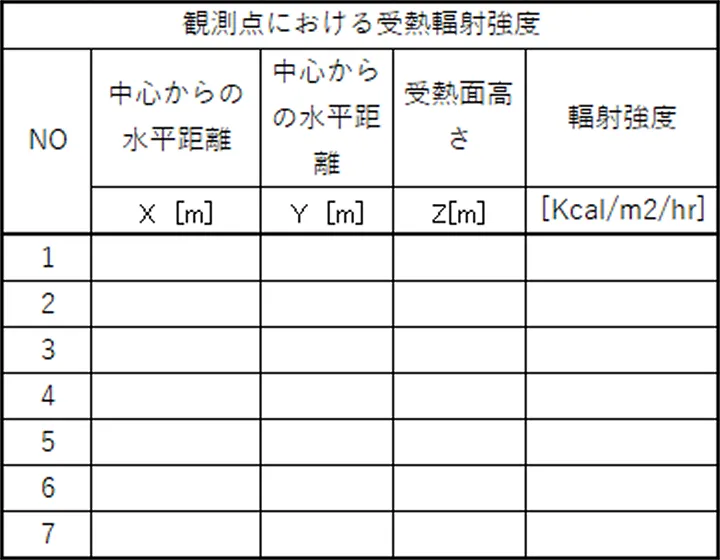
Heat radiation intensity at the observation point

You can specify a location and calculate the heat radiation intensity at that point. (A form for calculating the results is shown here.)

ファイアボールシミュレーション 観測点における受熱輻射強度

Vapor cloud explosion (VCE)

Calculation method

VCE (Volatile Ceiling Ejector) occurs when turbulence is caused by gas clouds pushed by an explosion passing through a narrow space, and it is generally unlikely to occur in open areas. However, it can occur in the case of extremely large jet streams.
Furthermore, the extent of the impact varies greatly depending on how long after the leak ignites and explodes, making it a complex issue. Our program employs the "TNT equivalent value method based on the Combi Guidelines." In addition to the "calculation method using the K value under the High Pressure Gas Safety Act," simulations can also be performed using a "calculation method that directly determines distance and pressure waves from flash rate and physical properties."

Accident examples

Please refer to the Combination Guidelines, which contain detailed information on disaster cases that occurred during the Great East Japan Earthquake.
There have been numerous accident reports from overseas, and here we will introduce two of them.

01 Flixborough, UK, June 1, 1974

Leakage from piping, 30 tons of cyclohexane (50% gas, 50% in mist form)
Ignition and explosion occurred 30 to 90 seconds later, killing 28 people, injuring 36, and destroying the entire plant. Turbulence was generated by the gas fire itself from the leak source, equivalent to 15-45 tons of TNT, with pressure waves of 5-10 bar.

02 UFA, West Siberia, Soviet Union, June 3, 1989

A leak from a liquefied natural gas pipeline caused a gas cloud to spread for about 8 km. A railway line was located about 800 m away, and trains coming from opposite directions crossed paths, causing the gas cloud to become agitated and enter a turbulent zone. The train then ignited the gas, resulting in two explosions, followed by flash fires in two directions. Trees within a 4 km radius of the explosion site were flattened. 645 people died.

VCE Simulation Example

VCE by butane

Input values and calculated values

This document summarizes the input values used in the simulation and the calculated values obtained.

VCEシミュレーション 入力値および計算値
The effects and range of blast pressure

The table below summarizes the "effects of blast pressure" as shown in various documents such as the Combo Guidelines, and the "range of blast pressure" calculated through simulations.
The colors in the "Color Map" section match the display colors in the attached "Blast Pressure Impact Area Diagram."

VCEシミュレーション 爆風圧の及ぼす影響と到達距離
Blast pressure effect area diagram

This map illustrates the area affected by blast pressure. The color coding of the affected area corresponds to the colored areas shown in "Effects and Reach of Blast Pressure."

VCEシミュレーション 爆風圧の影響範囲図
Blast pressure at the observation point

You can specify a location and calculate the blast pressure at that point. (A form for calculating the results is shown here.)

VCEシミュレーション 観測点における爆風圧

Flashfire

Evaluation method

Our gas diffusion program simulates spaces with concentrations above the lower explosive limit (usually 50% of the lower explosive limit is used as a safety benchmark), and a 3D concentration map shows the area where a flashfire would occur. People and property within this area could suffer extremely high damage. The flashfire ends instantly, and the fire returns to the source of the leak, leading to a jetfire or containment dike fire.

Accident examples

There have been numerous accident reports from overseas, and here we will introduce two of them.

01

Donnellson, Iowa, USA, August 3, 1978

An 838cm crack in an 8-inch liquefied propane transport line (1,200 psiG) caused a leak, and the evaporation of the gas cloud spread along the terrain. The gas cloud spread to 30.4 hectares, including forests, farms, and a highway. The gas ignited, destroying farms and cars, killing two people. Three people on the highway suffered severe burns (90%), one of whom later died. Flames continued to shoot up to 120m high from the leak site.

02

Lynchburg, Virginia, USA, March 9, 1972

A trailer (carrying pressurized liquefied propane) overturned while trying to avoid an oncoming vehicle, crashing into a rock and damaging the tank, causing 8,800 kg of propane to leak. To the right was a sheer cliff and forest, and to the left was a valley (about 20m below). There were houses 60m away, and the following vehicle and driver were about 80m away, while the people in other following vehicles were 135m away. When the gas cloud spread to the houses 60m away, it ignited from the truck, burning like a fireball with a diameter of 120m. The truck driver died instantly, and the people in the following vehicles, who were outside the gas cloud, suffered severe burns.

Flashfire Simulation Example

A case in which propane gas leaked from a spherical propane tank and spread beyond the site boundary from the containment dike.

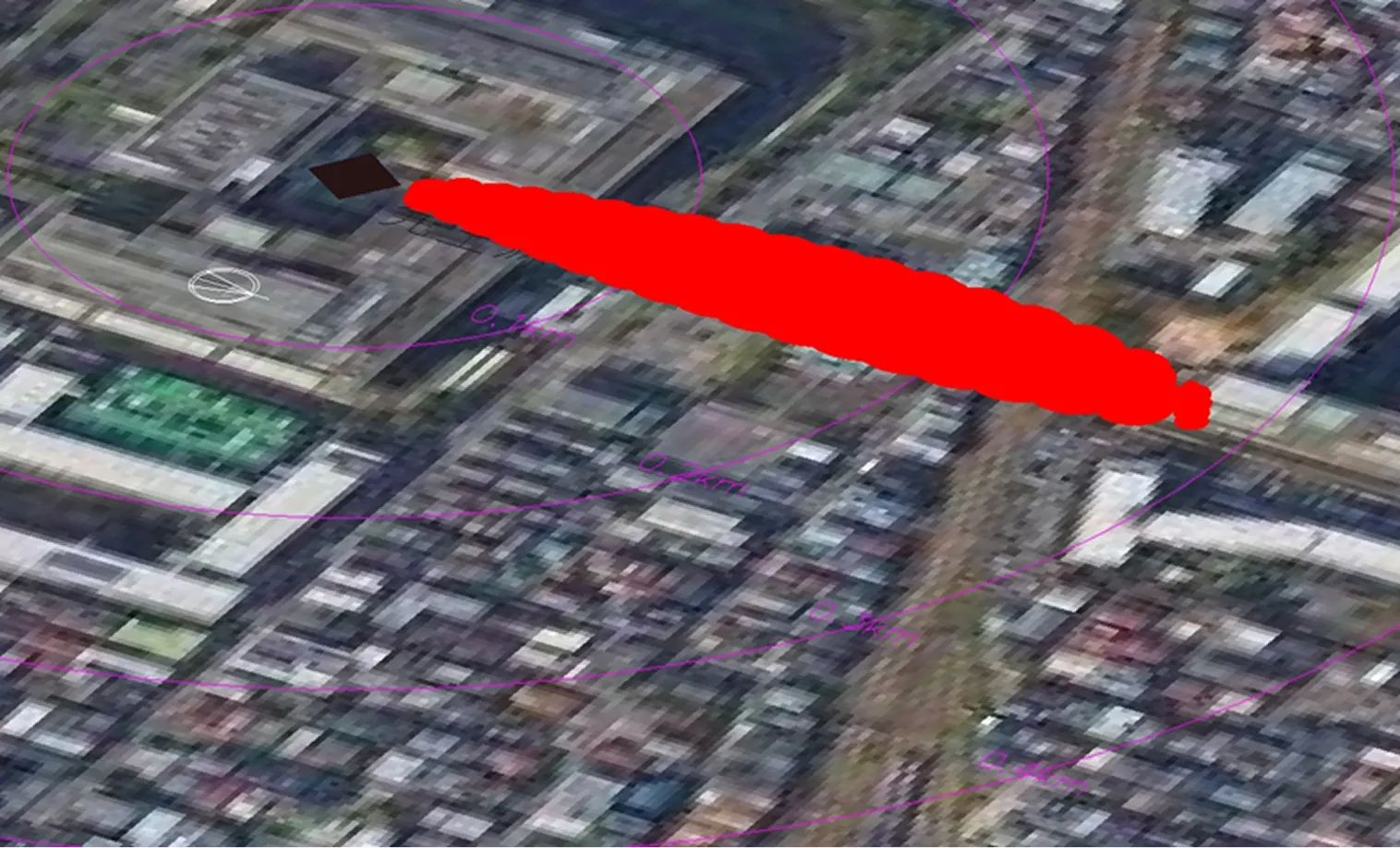
This diagram illustrates the flash fire area, where the concentration exceeds 50% of the lower explosive limit (LEL). Since the flash fire area (red area in the diagram below) is displayed on AutoCAD's 3D layout or map, it's easy to identify dangerous areas, including vertical dimensions, for buildings and other structures.

フラッシュファイアシミュレーション フラッシュファイア発生範囲図