
Plant disasterRisk assessment

In plant disastersrisk

There are three main risks associated with plant disasters.

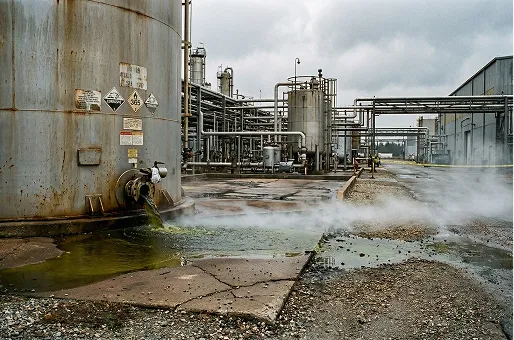
危険物の漏洩とガス拡散

01 Leakage of hazardous materials and gas diffusion

  • leakage
  • Spread of liquid
  • evaporation
  • Losses of life due to gas dispersion
爆発

02 Explosion

  • Vapor cloud explosion (VCE)
    (Vapor Cloud Explosion)
  • Flash Fire
  • BLEVE (Boiling Liquid Expanding Vapor Explosion)
  • Fire Ball
火災

03 Fire

  • Radiant heat damage
  • Boilover

Evaluation method

In plant disaster risk assessment, the first step is to extract initial events related to these risks and determine the frequency of disaster occurrence from those initial events. Furthermore, the impact of a disaster if it occurs is determined.
The risk level is determined using the frequency and impact of each initial event, and this information is presented as a basis for deciding the urgency and necessity of countermeasures.

Step 1 Initial Events
Step 2 Each disaster
Frequency assessment
Step 3 Each disaster
Impact assessment
Step 4 Plant disaster risk
Level evaluation

1. Initial Events

In plant disasters, the leakage of hazardous materials is often the initial event, so we begin our investigation by considering the leakage as the initial event. If the cause of the leakage is operational error or equipment failure, we trace back further and consider the operational error or failure as the initial event. On the other hand, in cases such as cable fires in electrical rooms that do not involve hazardous materials, or building fires caused by lightning strikes, the fire itself is considered the initial event.
Choosing the right initial approach is crucial and requires deep knowledge and experience with the plant. Based on our many years of experience and proven track record, we will propose the optimal solution.

2. Assessment of the frequency of each disaster

The specific procedure for assessing the frequency of occurrence is as follows:

Flowchart for evaluating incidence frequency

1. Calculation of occurrence frequency

For each initial event, an event tree is developed, and the probability of errors, malfunctions, etc., is applied to each event to determine the frequency (times/year) in which disasters occur.
This work requires plant documentation such as layout diagrams, P&ID flow diagrams, and equipment data. Furthermore, probabilities of errors and failures will be assessed using disaster prevention assessment guidelines for petrochemical complexes, nuclear-related data, or publicly available data from the US and EU.

2. Calculation of relative priority (if necessary)

If you want to determine relative priority, you can also evaluate it using a relative disaster level index, which is based on the highest frequency of disaster occurrence among each initial event.

3. Assessment of the impact of each disaster

The specific steps for impact assessment are as follows:

Impact Assessment Process

1. Selection of evaluation indicators

Indicators for evaluating the impact include various losses such as human casualties caused by the disaster, construction costs for rebuilding facilities, losses due to business closures, and losses due to reputational damage. In some cases, combinations of these may also need to be considered. The priority given to each indicator will be determined in consultation with the customer, based on their safety policies and philosophy.

2. Setting the impact level classification

We determine the degree of impact from a disaster by setting impact categories for each indicator. When setting the categories, we refer to disaster prevention assessment guidelines for petrochemical complexes, nuclear-related data, or data published in the United States and the EU.

3. Calculation of relative priority (if necessary)

We determine the degree of impact from a disaster by setting impact categories for each indicator. When setting the categories, we refer to disaster prevention assessment guidelines for petrochemical complexes, nuclear-related data, or data published in the United States and the EU.

4. Conduct disaster simulations (if necessary)

Furthermore, if it is necessary to estimate the physical extent of the impact caused by a disaster, we will conduct a disaster simulation. We will present the extent of the impact using our proprietary plant disaster simulation software.
For details on each simulation technique, please refer to the Plant Disaster Prevention Simulation documentation.

4. Plant disaster risk level assessment

The disaster risk level (R) associated with each initial event is calculated using the following formula, based on the disaster frequency (F) obtained from the frequency assessment and the impact (S) obtained from the impact assessment.

Disaster risk level calculation formula

R = F × S

The risk level is classified according to the disaster risk level (R), as shown in the example in the diagram below, and this classification is used as a basis for determining the urgency and necessity of countermeasures.

横スクロールできます
Risk level
evaluation
Disaster risk level (R) remarks
From To
EXTREME Risk 1.00E-03 ~ We will implement risk reduction measures urgently.
HIGH Risk 1.00E-04 1.00E-03 We will implement risk reduction measures as quickly as possible.
MODERATE Risk 1.00E-05 1.00E-04 While not urgent, it is desirable to implement risk reduction measures.
LOW Risk ~ 1.00E-05 While no specific risk mitigation measures are required, safety management will be implemented.