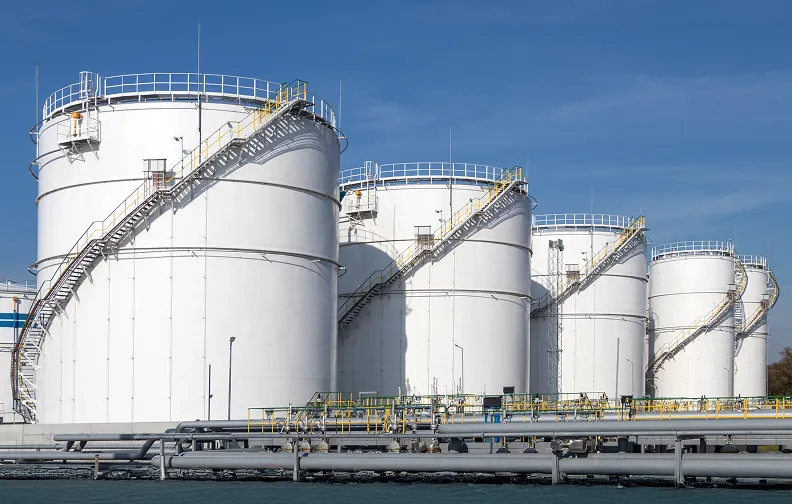
Firefighting plans and firefighting tactics

Business content

Using a simulation program developed by our company, we will consider the appropriate placement of firefighting equipment such as fire trucks and foam cannons in the event of a tank fire or a process area fire.

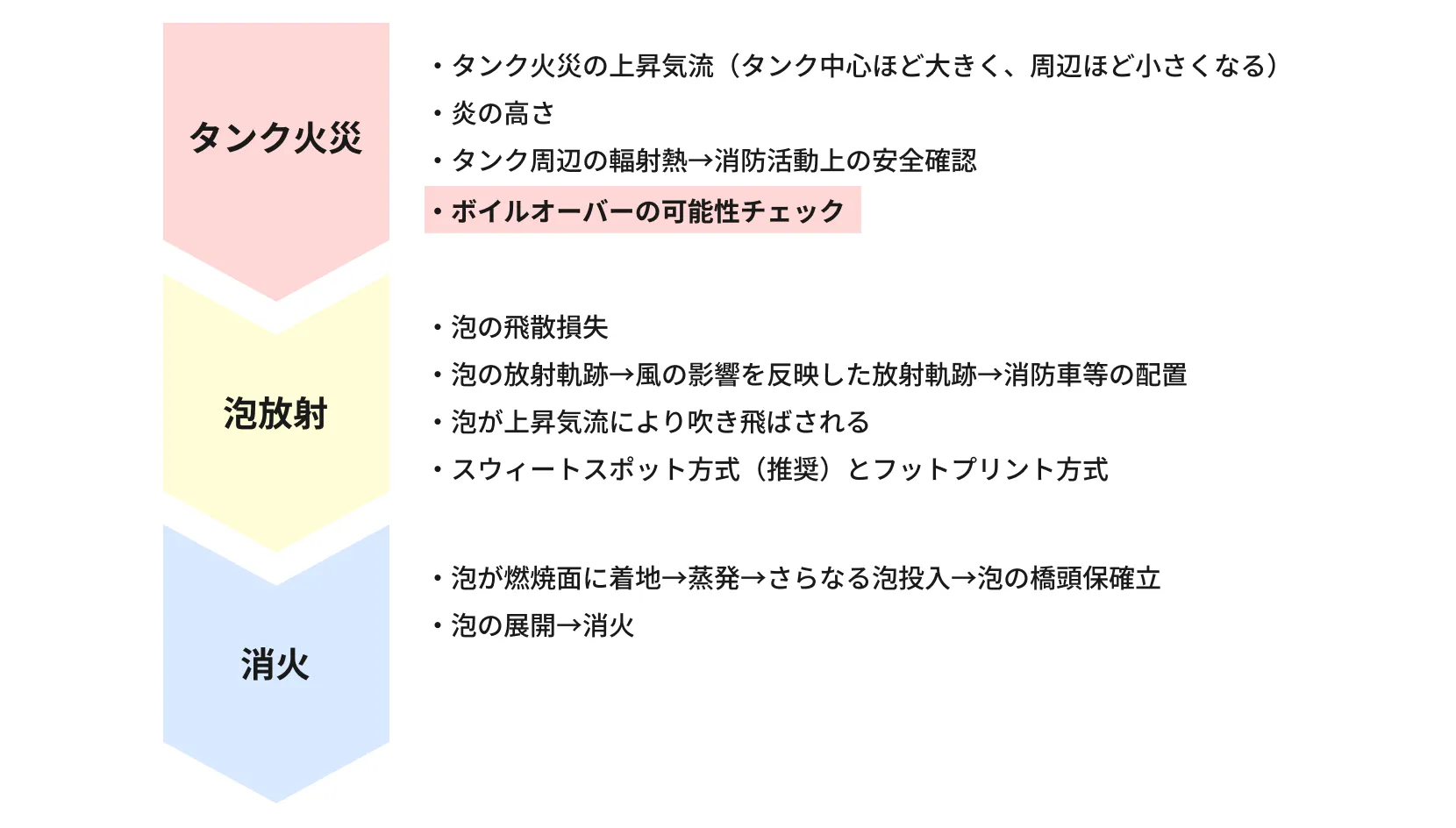
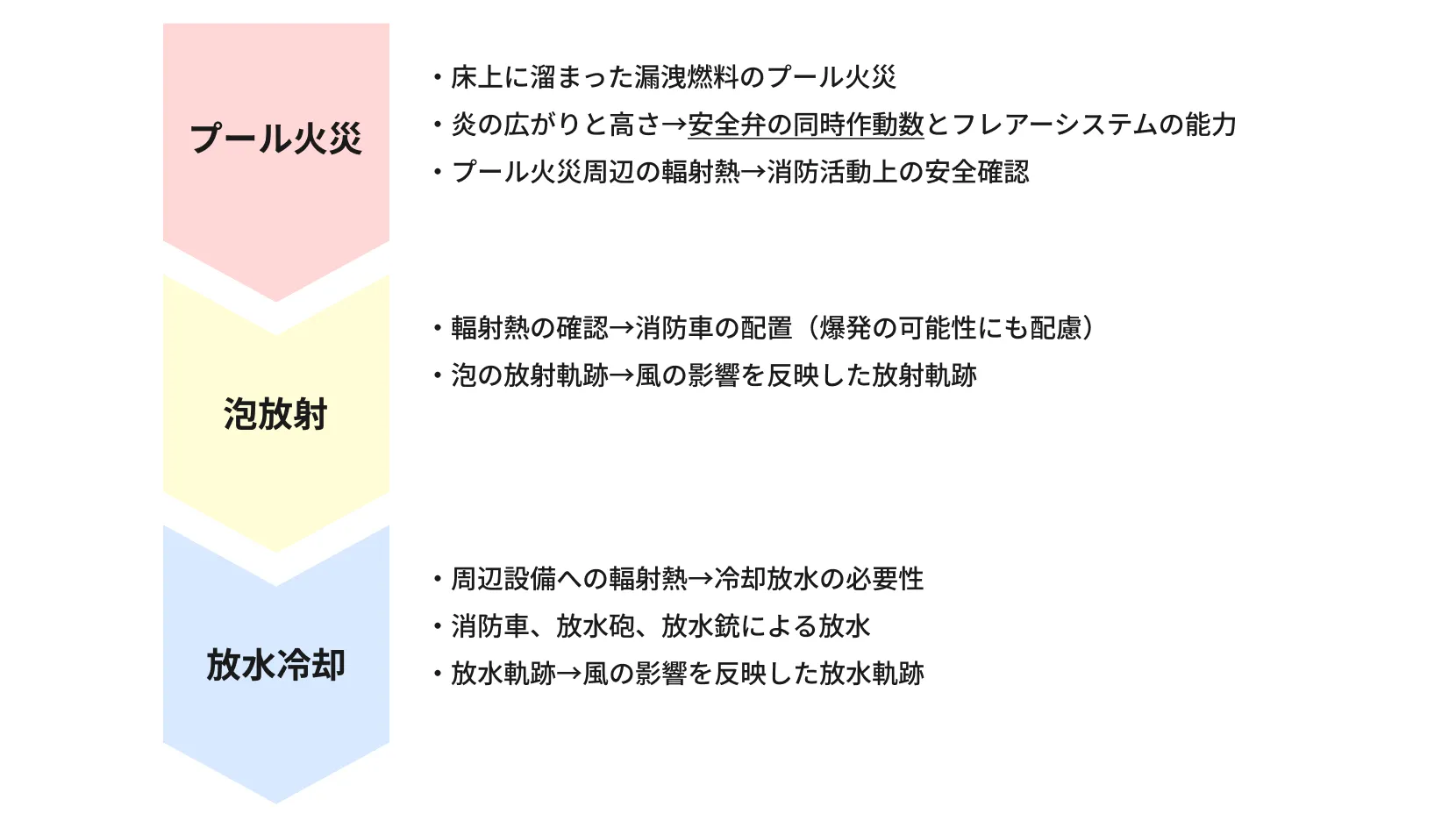
In our considerations, we will determine the important factors for firefighting tactics through simulation, as shown in the table below. We will then propose the key points derived from the simulation results as part of our firefighting strategy.
Furthermore, we will investigate the actual practices and approaches to firefighting tactics used overseas, such as the "Firefighting Tactics for Large Crude Oil Tank Fires" exemplified below, and incorporate that information into our report.

横スクロールできます
Factors to consider Simulation program used
Radiant heat and water discharge depending on wind direction and wind speed(Effect on foam)
Radiant heat intensity range that does not endanger firefighters
The necessity of discharging water to adjacent tanks and equipment based on radiation intensity.
Estimation of the likelihood and timing of a boilover.
Estimation of the time required to extinguish a tank fire
Potential explosion and affected area
The diffusion range of flammable gas generated by a leak (above the lower explosive limit)
Use the 3D viewer to make simulation results more "realistic".

By using the dedicated "FM Viewer," you can freely manipulate the simulation results on your PC. You can pinpoint and zoom in on the area you want to see, dramatically improving your understanding of the analysis accuracy compared to conventional still images.

Services offered: Tank fire extinguishing / Radiant heat calculation / Water and foam discharge

Further details are explained on the FM Viewer introduction page.

FM Viewer
reference

Firefighting tactics for large crude oil tank fires

To respond to large floating-roof crude oil tank fires, the deployment of high-capacity foam water cannon systems is mandated by the Petrochemical Complex Disaster Prevention Act, and these systems have already been deployed. However, when a fire actually occurs, various decisions will be required depending on the situation.
Regarding firefighting tactics and problems in large tank fires, there is a wealth of useful information available, primarily in overseas standards and literature, including recommendations from LASTFIRE (Large Atmospheric Storage Tank Fires), which is comprised of major oil companies.

Our company organizes this information, references actual fire reports, and leverages our experience and knowledge in plant disaster prevention engineering to compile and report on firefighting tactics manuals as standard or reference documents.

Main survey contents

  • LASTFIRE's proposal
  • API standard
  • NFPA standards
  • foreign literature
  • Overseas fire and firefighting experience
  • Potential for boil-over and countermeasures (using our company's developed hot zone and post-fire cooling estimation programs)
  • Consideration and practical application of appropriate responses depending on the situation, such as when a floating roof is sinking while tilted.
  • Is it possible to extract the oil?
  • Post-fire countermeasures (including the cooling estimation program developed by our company)

Tank fire

Examination of firefighting tactics

We will also conduct simulations to assess the likelihood of a tank fire going down, including the possibility of boilover.

タンク火災シミュレーション結果

Creating a site plan

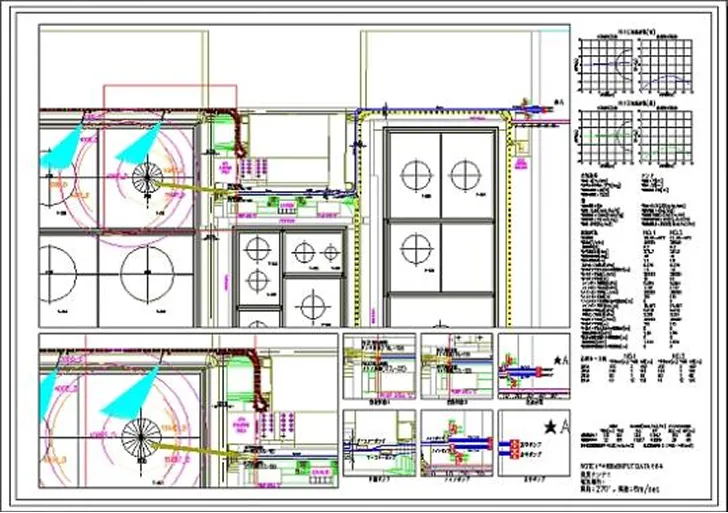
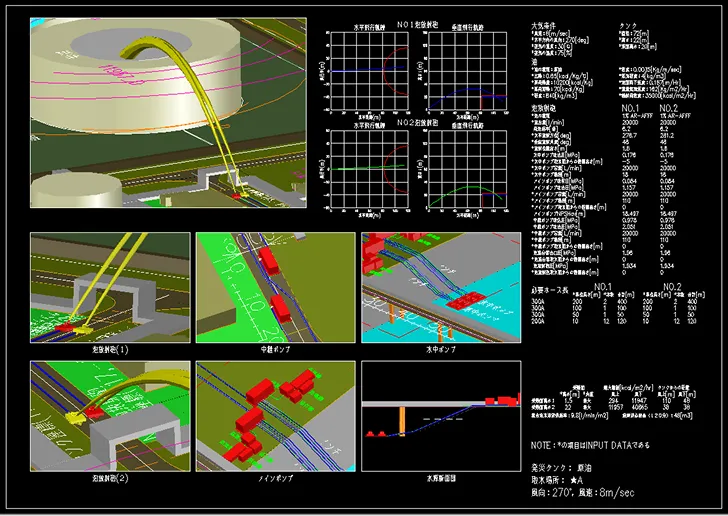
We will create a layout plan for the appropriate placement of firefighting equipment, such as fire engines, water cannons, water cannons, and hoses, required for each fire-affected tank. This layout plan incorporates all the requirements for layout consideration outlined in the Fire Prevention Plan Creation Guidelines, and we believe it can be used directly as documentation for submission to government agencies.

Content to be included in the layout plan

  • Bubble Flight Paths - Graph and 3D Display
    This displays the flight path of bubbles not only in calm conditions, but also when there is wind.
  • Radiant heat map
    You can check if the rocket launcher is located in an area with an atmospheric pressure of 2,000 [kcal/m2/h] or less.
  • Hose laying route
    This displays the route from the rocket launcher to the water intake.
  • Placement of equipment necessary for firefighting
    The arrangement of main pumps and relay pumps, large chemical fire trucks, high-rise water cannons, foam concentrate transport vehicles, water cannons, water cannons, etc.
  • Enlarged view of the area around each piece of equipment to confirm the placement space for each piece of equipment.
  • Enlarged view to check for the presence or absence of foam radiation obstructions.
    It can be viewed from any angle.
  • Pressure in each device
  • Other necessary information

*In the case of a large-capacity foam discharge system, a mobile main pump or relay pump may be required. Also, even when using a fixed foam discharge port for firefighting, it may be necessary to discharge water to the affected tank or adjacent tanks.

In addition to the above, we will also submit an Excel sheet containing the following information as needed.

  • Pressure in each device
  • The placement height of each piece of equipment and other matters necessary for water supply.

When using a mobile relay pump, you need to consider the pressure resistance of the hose and the suction pressure when determining its placement, but this can be checked using our program.

Please note that a 3D layout map of the tank's surroundings is required to check for the presence or absence of radiation obstructions. However, if you have a 2D layout map created in AutoCAD, we can convert it to 3D for you.
Furthermore, even if you don't have a site plan, we can create a 3D site plan from aerial photographs, so please feel free to contact us.

reference

Firefighting plan diagram using a large-capacity foam spraying system

To respond to large floating-roof tank fires, the deployment of high-capacity foam water cannon systems is mandated by the Petrochemical Complex Disaster Prevention Act, and these systems have already been deployed. However, their actual operation requires advanced training and a well-planned firefighting strategy.
Our company has received positive feedback for our accurate simulations of tank fire extinguishing, which allow us to consider the placement of fire extinguishing equipment such as large-capacity foam cannons, large-diameter hoses, and fire pumps.

大容量泡放射システムによる警防計画図1 大容量泡放射システムによる警防計画図2

Process area fire

Examination of firefighting tactics

We will also conduct simulations to simulate a pool fire with leaking fuel at a designated location, illustrating the spread and height of the flames, and confirming the equipment engulfed in flames, as well as the safety distance of surrounding equipment and firefighters due to radiant heat.

プロセスエリア火災シミュレーション結果

Creating a site plan

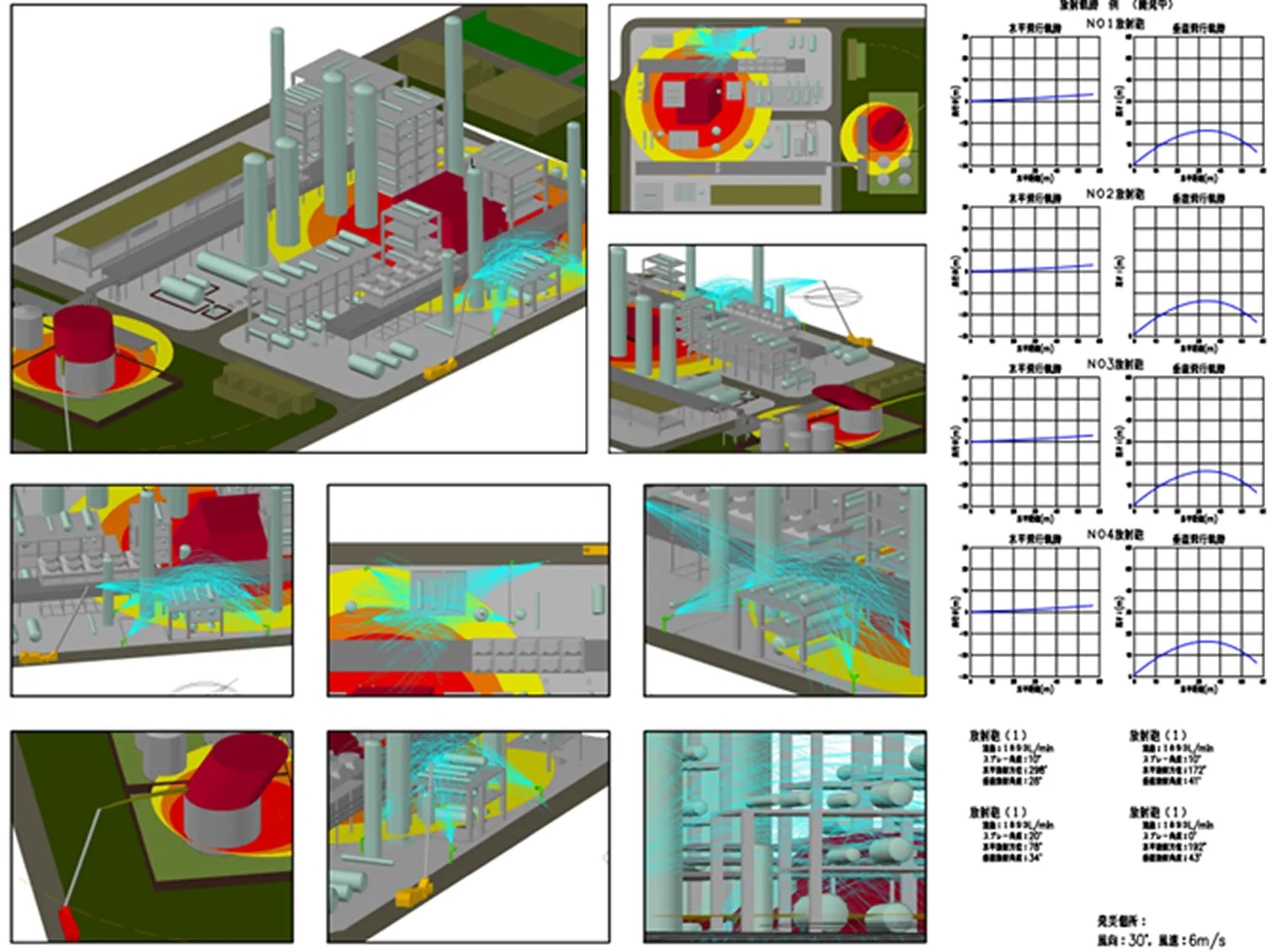
We create appropriate layout diagrams for firefighting equipment such as fire trucks, water cannons, water cannons, and hoses, which are necessary for each type of fire.

Content to be included in the layout plan

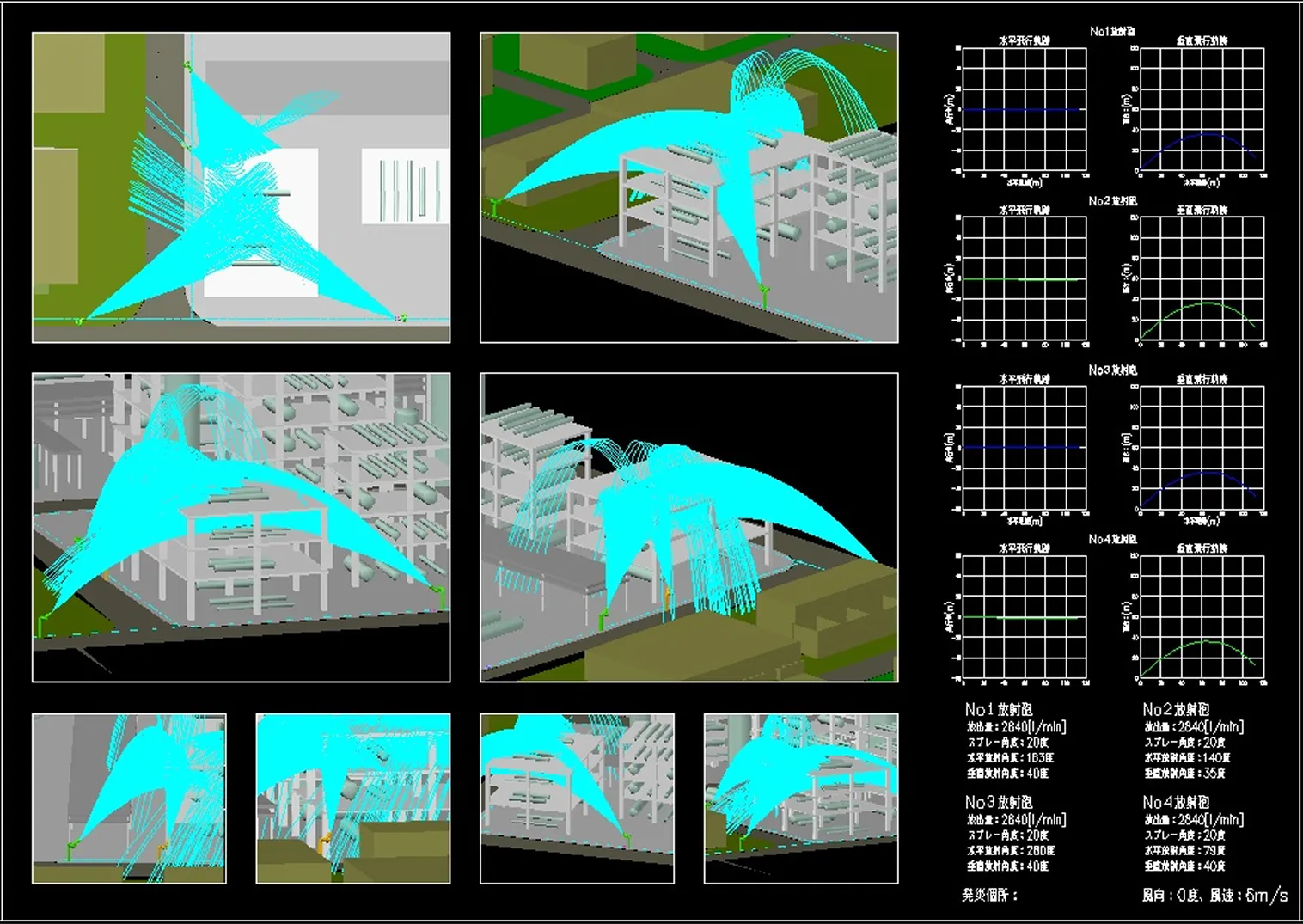
  • Flight trajectories of foam and water from fire trucks, etc. - Graph and 3D display
    This displays the foam flight path not only in calm conditions but also in windy conditions. It's particularly useful for checking whether sufficient water can be sprayed onto equipment installed inside structures.
  • Radiant heat map
    You can check if the rocket launcher is located in an area with an atmospheric pressure of 2,000 [kcal/m2/h] or less.
  • Hose laying route
    This allows you to check whether it will obstruct vehicle traffic.
  • Placement of equipment necessary for firefighting
    Deployment of large chemical fire trucks, high-rise water cannons, foam concentrate transport vehicles, water cannons, water cannons, etc.
  • Enlarged view of the area around each piece of equipment to confirm the placement space for each piece of equipment.
  • Enlarged view to check for the presence or absence of foam and water discharge obstructions.
    It can be viewed from any angle.
  • Pressure in each device
  • Other necessary information

*The appropriate placement of firefighting equipment will be planned considering factors such as the water discharge range for water and foam discharge, the safe range of radiant heat, and safe positions in the event of an explosion.

Please note that a 3D layout of the process area is necessary to check for the presence or absence of radiation obstructions, but it is sufficient to display only large structures such as equipment and structures. If you have a 2D layout created in AutoCAD, we can convert it to 3D, so please feel free to contact us.

reference

Diagram illustrating leak fire and water spraying cooling plan in the process area.

The diagram below simulates the cooling of surrounding equipment using water cannons and fire trucks in the event of a leak fire around the equipment. This allows for the consideration of fire prevention measures using water under various conditions. The diagram also examines the use of foam discharge from fire trucks to extinguish tank fires.

プロセスエリア漏洩火災放水冷却シミュレーション1

The diagram below simulates the cooling of surrounding equipment using water cannons and fire trucks in the event of a leak fire around the equipment. This allows for the consideration of fire prevention measures using water under various conditions. The diagram also examines the use of foam discharge from fire trucks to extinguish tank fires.

プロセスエリア漏洩火災放水冷却シミュレーション2
Adaptation to diverse conditions
  • Simulation that takes wind effects into account
    While water and bubble radiation are greatly affected by wind, water/bubble radiation simulations accurately reproduce radiation trajectories under windy conditions. Simulations are possible under a wide range of wind direction and speed conditions.
  • Supports a variety of nozzle shapes
    For water nozzles, we support not only direct (straight) spray but also calculations based on the spray angle in the case of misting.
  • Covers both aspirator and non-aspirator types.
    The foam discharge nozzle supports both "aspirator type" nozzles that release foam and "non-aspirator type" nozzles that foam during flight.
  • Individual adjustments based on manufacturer data
    Based on the manufacturer's provided radiation data for windless conditions, it is also possible to customize and optimize the radiation trajectory.