Leakage, evaporation, and diffusion

Leakage, evaporation, and diffusionAbout the simulation

Our company has focused on "leakage of hazardous materials," which is the primary initial event in disasters at chemical plants and similar facilities, and has developed a simulation program that analyzes a series of phenomena, from the spread of leaked liquid to evaporation and gas diffusion.

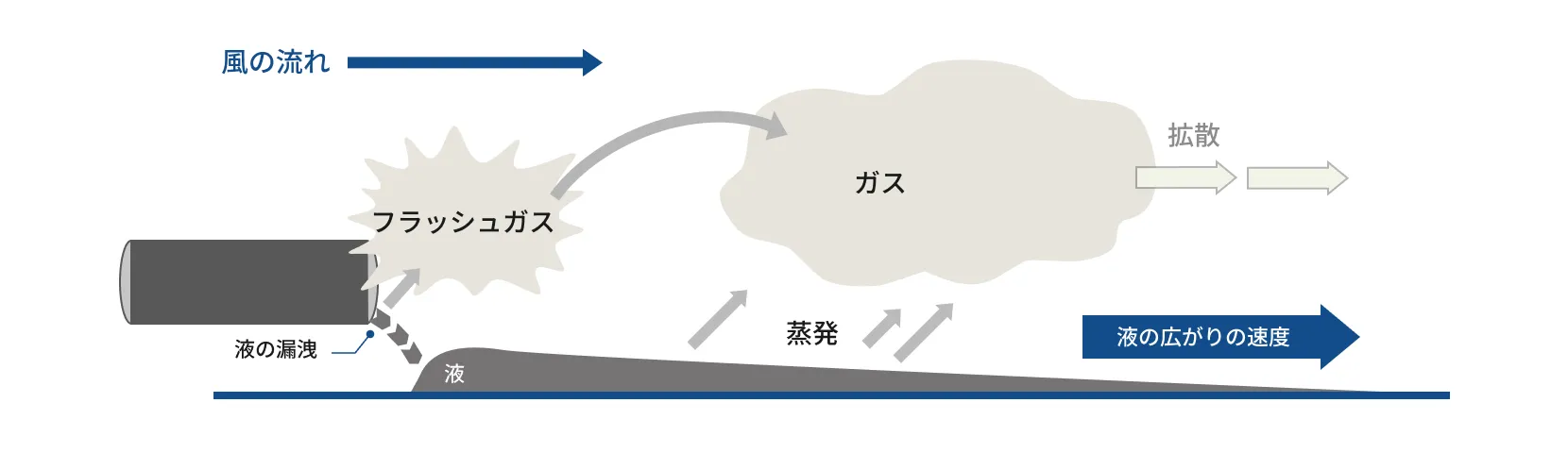
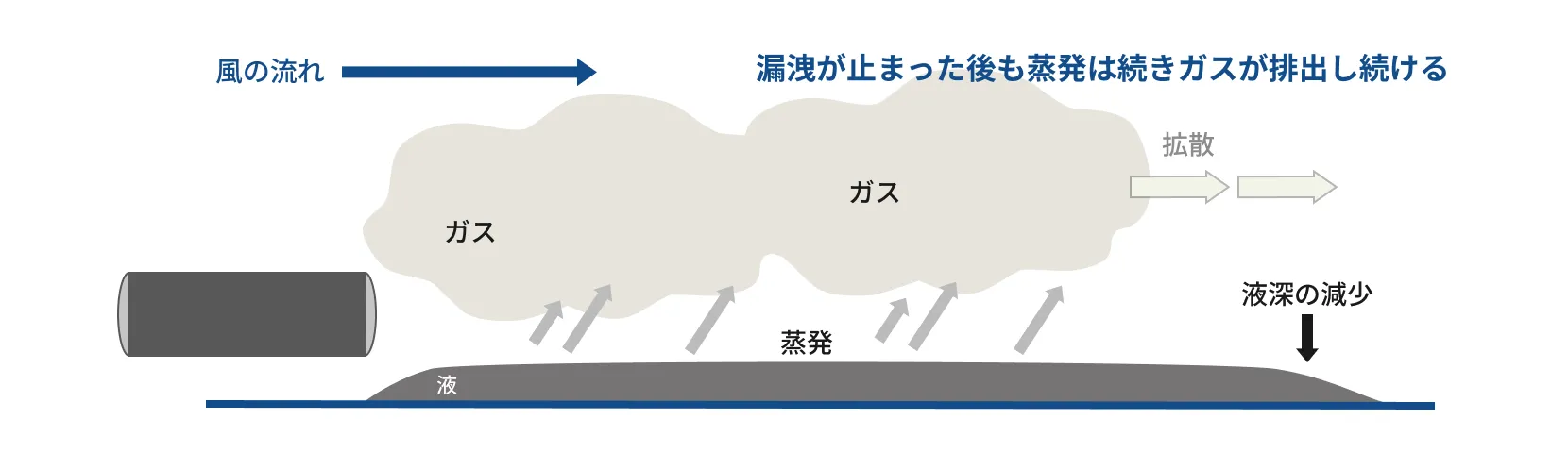
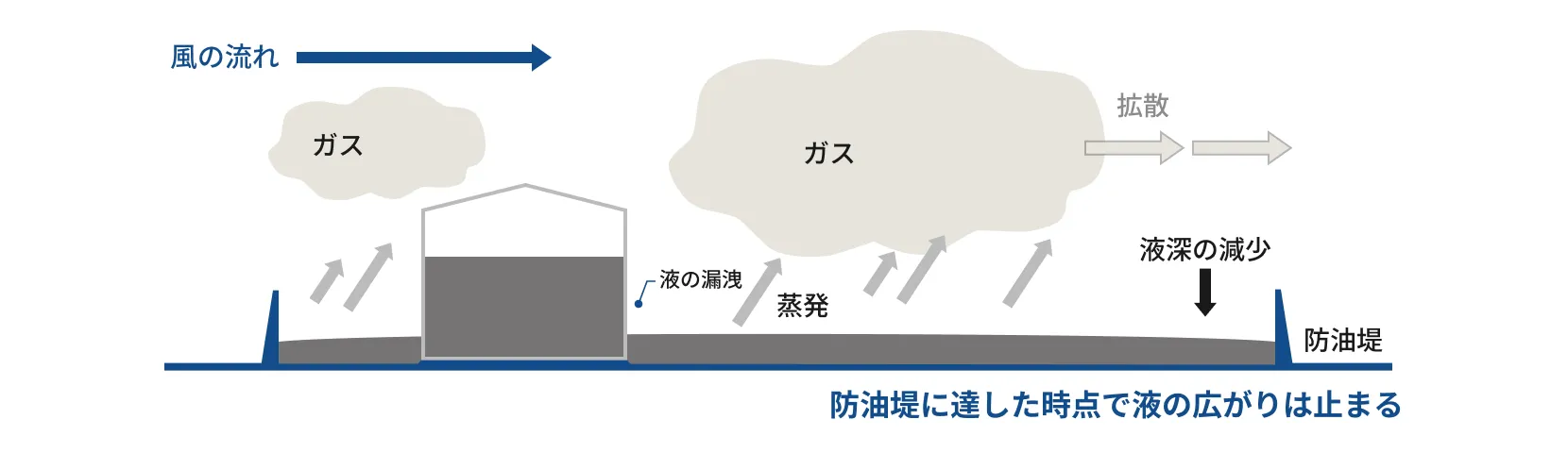
As shown in the diagram below, when a liquid leaks, it spreads across the floor and simultaneously evaporates, causing the gas to diffuse. Based on the constantly changing situation, the system simultaneously calculates the amount of leakage, liquid spread, and evaporation. By linking this calculation data to a gas diffusion simulation, the progression of gas diffusion over time from the time of the leak is visualized as a "concentration map." This supports a precise risk assessment based on the sequence of events in a disaster.

In the absence of oil containment dikes or liquid containment dikes

Phenomena during liquid leakage

液漏洩中の現象

Phenomena after the leak has stopped

漏洩停止後の現象

In the case of oil containment dikes/liquid containment dikes

Liquid-stopping effect of the dike

堤による液止め効果

catalog

You can download the catalog for leak, liquid spread, evaporation, and gas diffusion simulations here.

漏洩・液の広がり・蒸発・ガス拡散シミュレーション カタログ表紙

Leakage and evaporation calculations

leakage

Generally, leaks of hazardous materials handled in plants and factories can be classified into the following five types:
Our program can calculate any type of data leak.

横スクロールできます
Type of leak Typical storage methods Flash calculation Leakage amount calculation
Gas-only leakage Hydrogen gas tanks, etc. _
  • Gas-only leakage
  • Release from safety valve
Open to the atmosphere
Leakage of stored liquid
atmospheric pressure tank _
  • Direct leakage from the container
  • Leakage via piping
Under atmospheric pressure
Leakage of cryogenic storage liquid
LNG tanks, etc. _
  • Direct leakage from the container
  • Leakage via piping
Under pressure
In a state of vapor-liquid equilibrium
Liquid leakage
LPG spherical tanks, etc.
  • Direct leakage from the container
  • Leakage via piping
    (Two-layer flow calculation)
Pressurized by another gas
Liquid leakage
Hydrogen fluoride tanks pressurized with nitrogen gas, etc.
  • Direct leakage from the container
  • Leakage via piping
    (Two-layer flow calculation)

Spread and evaporation of leaked liquid

Various methods have been proposed for calculating the spread and evaporation rate of leaked liquid, and our program can handle all of them.
For liquid diffusion calculations, the USA-FEMA model is generally recommended.
Furthermore, regarding the evaporation rate, we recommend the method used in the ALOHA program, which calculates it from the overall thermal balance surrounding the leaking liquid pool.
This method is extremely precise and complex because it takes into account many parameters in detail, such as latitude, longitude, and date/time for determining atmospheric stability and solar altitude, meteorological conditions like wind speed, and thermal conductivity of the floor surface.

Regarding the calculation of the spread of leaked liquid

横スクロールできます
Calculation method Calculation method
KHE-E-007
(High Pressure Gas Safety Association)
Used for low-temperature liquids such as LNG.
USA-EPA
(U.S. Environmental Protection Agency)
The calculation assumes a uniform liquid thickness of 1 cm.
USA-FEMA
(Federal Emergency Management Agency)
The area over which a liquid spreads is approximately proportional to the 1/2 power of the amount of liquid leaked.
ALOHA Program
(U.S. Department of Commerce, National Oceanic and Atmospheric Administration)
This method is similar to the one used by the KHK, and it spreads quickly.

Regarding the calculation of the evaporation rate of leaked liquid

横スクロールできます
Calculation method Calculation method
KHE-E-007
(High Pressure Gas Safety Association)
This is used for cryogenic liquids such as LNG, and only considers heat absorption from the ground.
USA-EPA
(U.S. Environmental Protection Agency)
The calculation shows that the gas is carried by the air velocity near the liquid surface, according to its vapor pressure.
USA-FEMA
(Federal Emergency Management Agency)
Estimated from the combustion rate of the liquid
US Air Force
(US Air Force)
Comparison calculation with experimental data for hydrazine
ALOHA Program
(U.S. Department of Commerce, National Oceanic and Atmospheric Administration)
Considering all aspects of heat balance, including heat input from sunlight, heat exchange with the atmosphere, and heat absorption from the ground.

Examples of leakage and evaporation calculations

A case in which butane leaked from a spherical tank into the containment dike for 10 minutes.

The amount of gas generated during a leak is the sum of the gas that immediately flushes out at the time of the leak and the gas that evaporates from the accumulated liquid. However, after the leak is stopped, only the evaporation of the accumulated liquid will occur over the next 10 minutes, and this evaporation will continue until all the liquid is gone.

漏洩量・液面積・蒸発量の時間変化(拡大)
液温度・蒸発速度の時間変化(拡大)

Gas diffusion simulation

Features

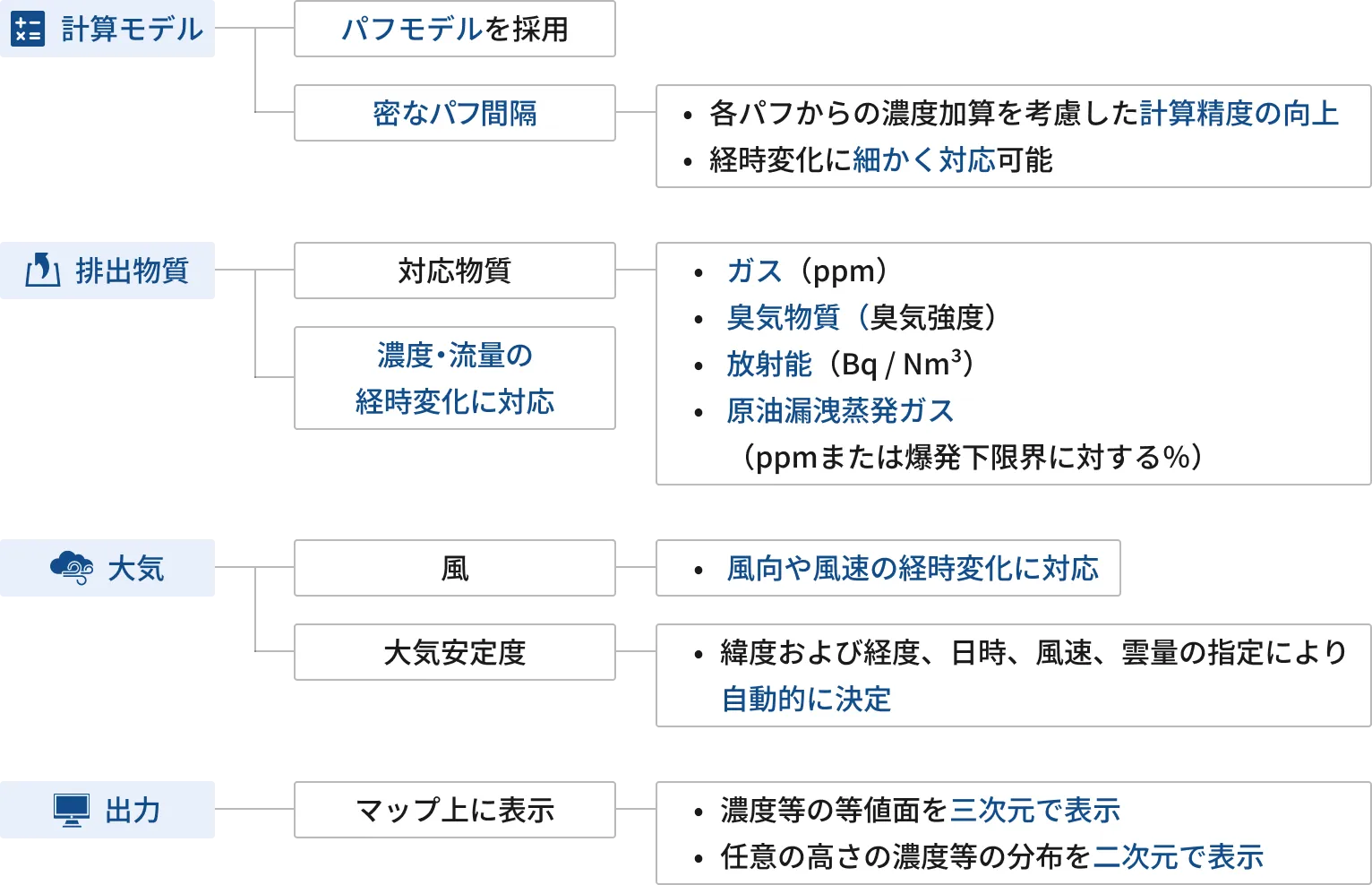
Our gas diffusion program employs a puff model with a proven track record in atmospheric diffusion evaluation. We maximize the density of the puffs to improve calculation accuracy.
Concentration/intensity distributions can be graphically displayed on a map in 3D or 2D. By pre-setting observation points, the temporal changes in concentration and intensity can be displayed graphically.
In addition to crude oil, for flammable gases, it is also possible to display the concentration distribution in ppm, as well as %LEL (explosive gases only, as a percentage of the lower explosive limit).

ガス拡散計算モデル

Gas diffusion simulation examples

A case in which butane leaked from a spherical tank into the containment dike for 10 minutes.

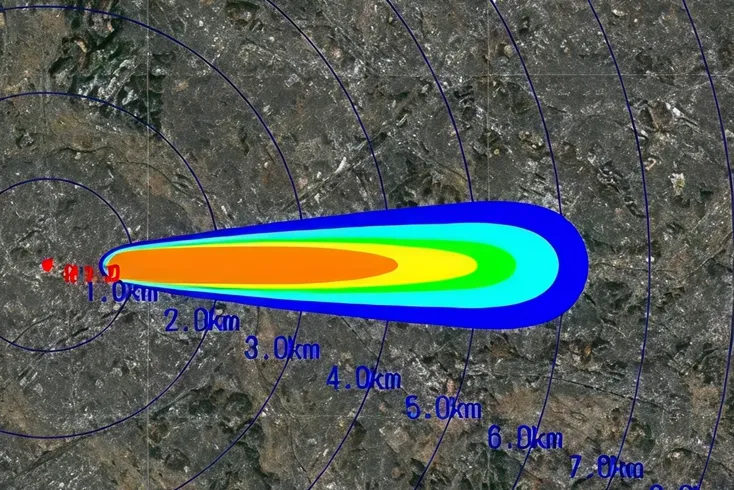
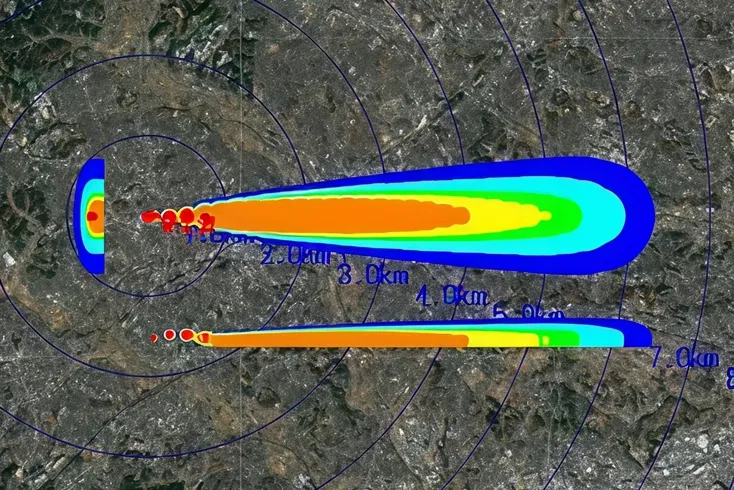
This is the output of the gas diffusion simulation program after inputting the aforementioned leakage and evaporation data.

2D and 3D maps

Two-dimensional display of concentration distribution map

2次元表示した濃度分布図

The height and position of the displayed density can be specified arbitrarily. It can also be overlaid on maps published by the Geospatial Information Authority of Japan.

3D display of concentration distribution map

3次元表示した濃度分布図

The concentration distribution shown on the left of the two-dimensional map:
If we consider the top of the map to be north, this is a three-dimensional concentration distribution viewed from the west side of a two-dimensional map.
The concentration distribution shown in the two-dimensional map below:
Three-dimensional concentration distribution viewed from the south.

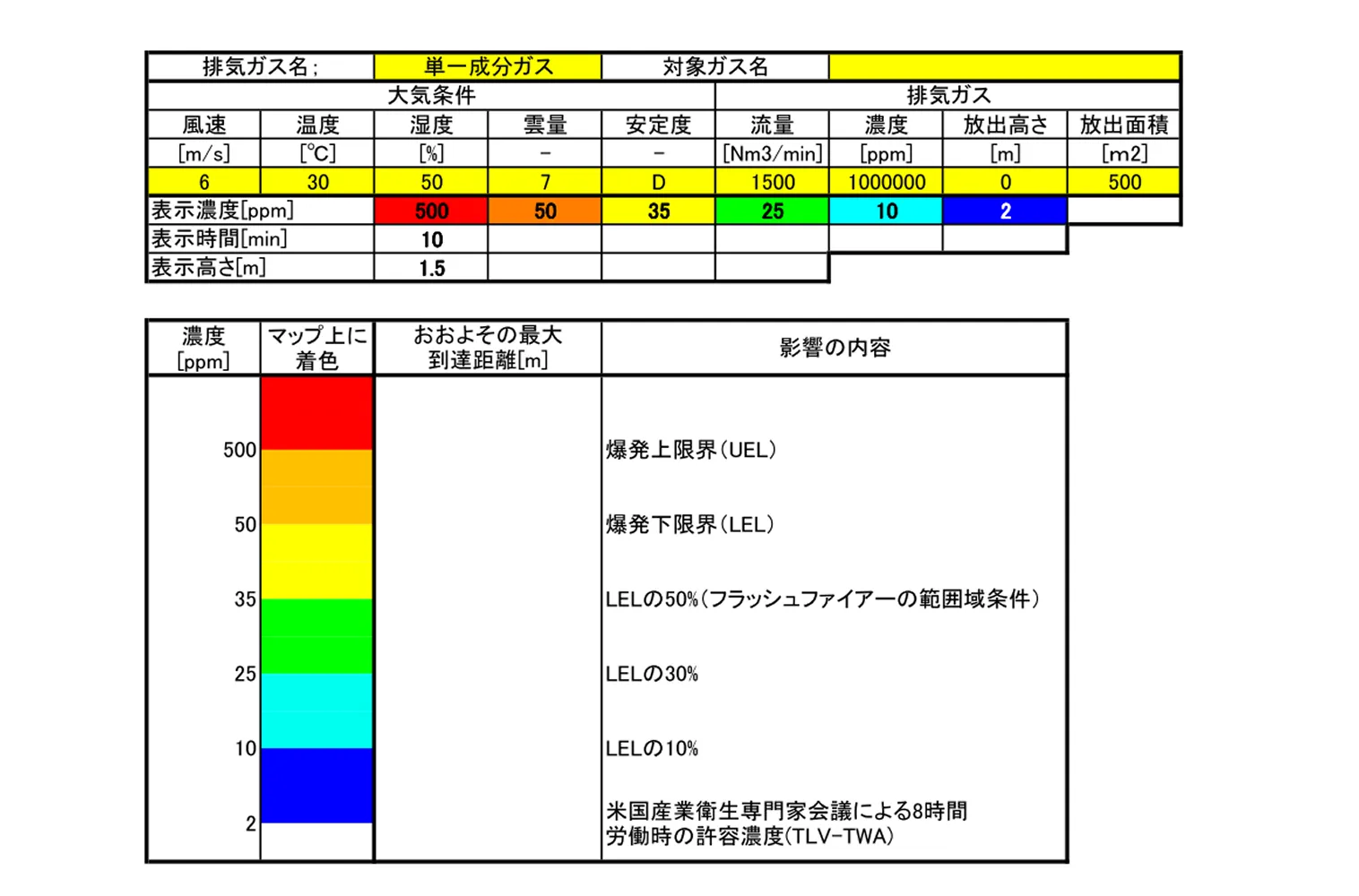
Calculation conditions and legend

The diagram below provides a clear summary of data such as calculation conditions, map display density, and display color. The display density is set based on various criteria, including the LEL (Low Energy Level) equivalent in ppm, safe working conditions, and risk levels related to human health.

計算条件・凡例