
Boilover

overview

Our company has developed a simulation program that can calculate the temperature and growth rate of the hot zone in the event of a full-scale fire in a large crude oil tank, as well as the change in oil temperature inside the tank after the fire is extinguished. This makes it possible to predict the likelihood and timing of boilover for individual crude oil distillation curves.
Furthermore, it allows us to predict the time required to cool the oil remaining in the tank after the fire has been extinguished.

Boilover occurredMechanisms and disasters

mechanism

A key characteristic of heat transfer in a fire is that the oil is heated from above. Therefore, convection is unlikely to occur, and heat is transferred through the oil from the combustion surface towards the bottom of the tank solely by conduction, resulting in an extremely slow rate of heat transfer downwards.
The mechanism of boilover is as follows:

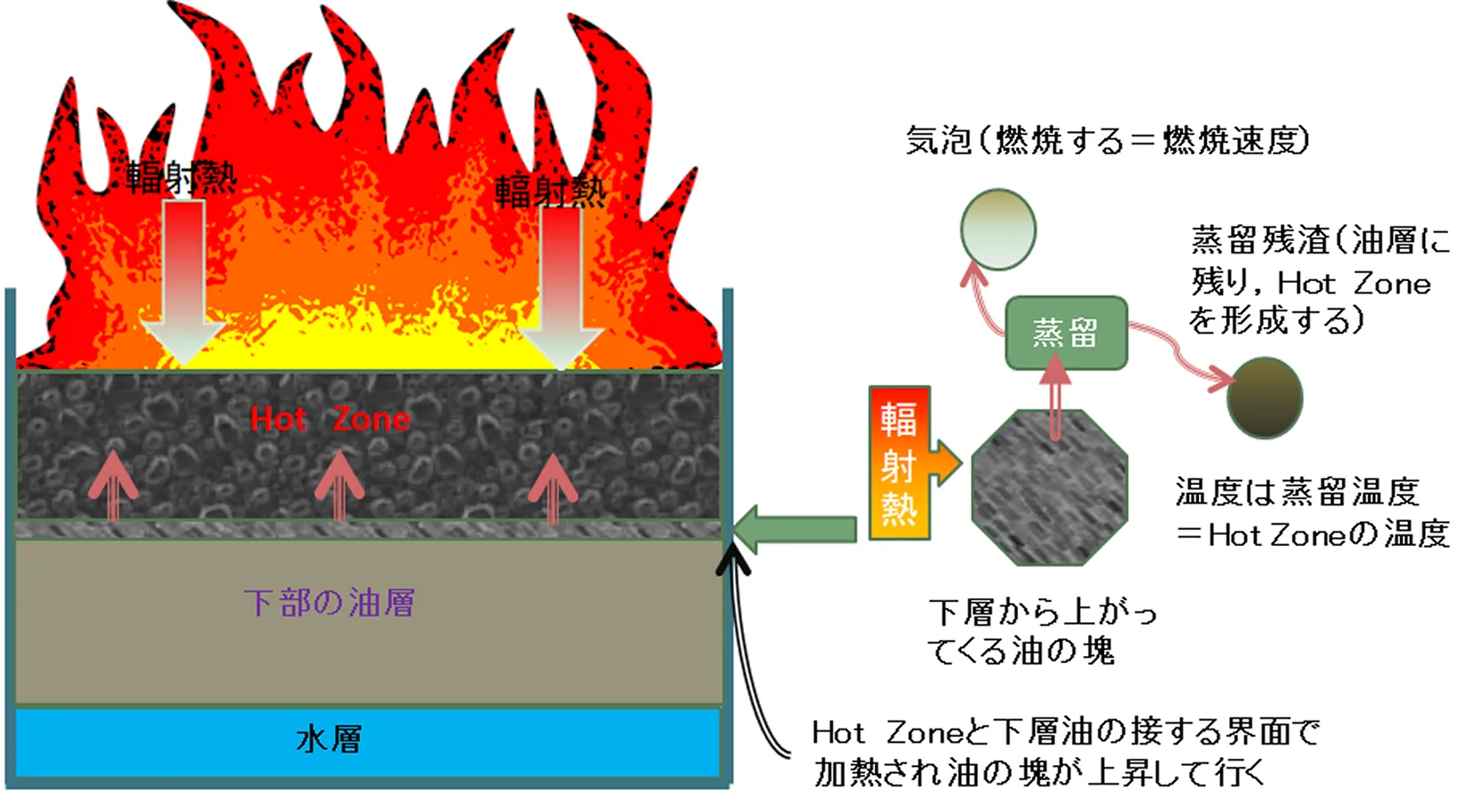
Step 01 Distillation by radiant heat

The oil is overheated by radiant heat from the combustion surface, causing distillation to occur.

Step 02 Distillation residue forms a hot zone.

Lighter fractions become gas, float to the surface of the liquid, and are burned, while the oil remaining after distillation (distillation residue) remains in the oil layer as hot oil, forming a hot zone.

Step 03 The width (height) of the hot zone is increasing.

Because heating of the oil continues at the interface where the hot zone and the lower layer of oil meet, distillation is repeated, and the width (height) of the hot zone increases over time.

Step 04 Boilover occurs upon contact with the water layer.

Eventually, the water comes into contact with the water layer at the bottom of the tank, causing the water to surge and the hot oil to erupt, resulting in a "boilover."

Mechanism of boilover
ボイルオーバー発生のメカニズム図解

Content of the disaster

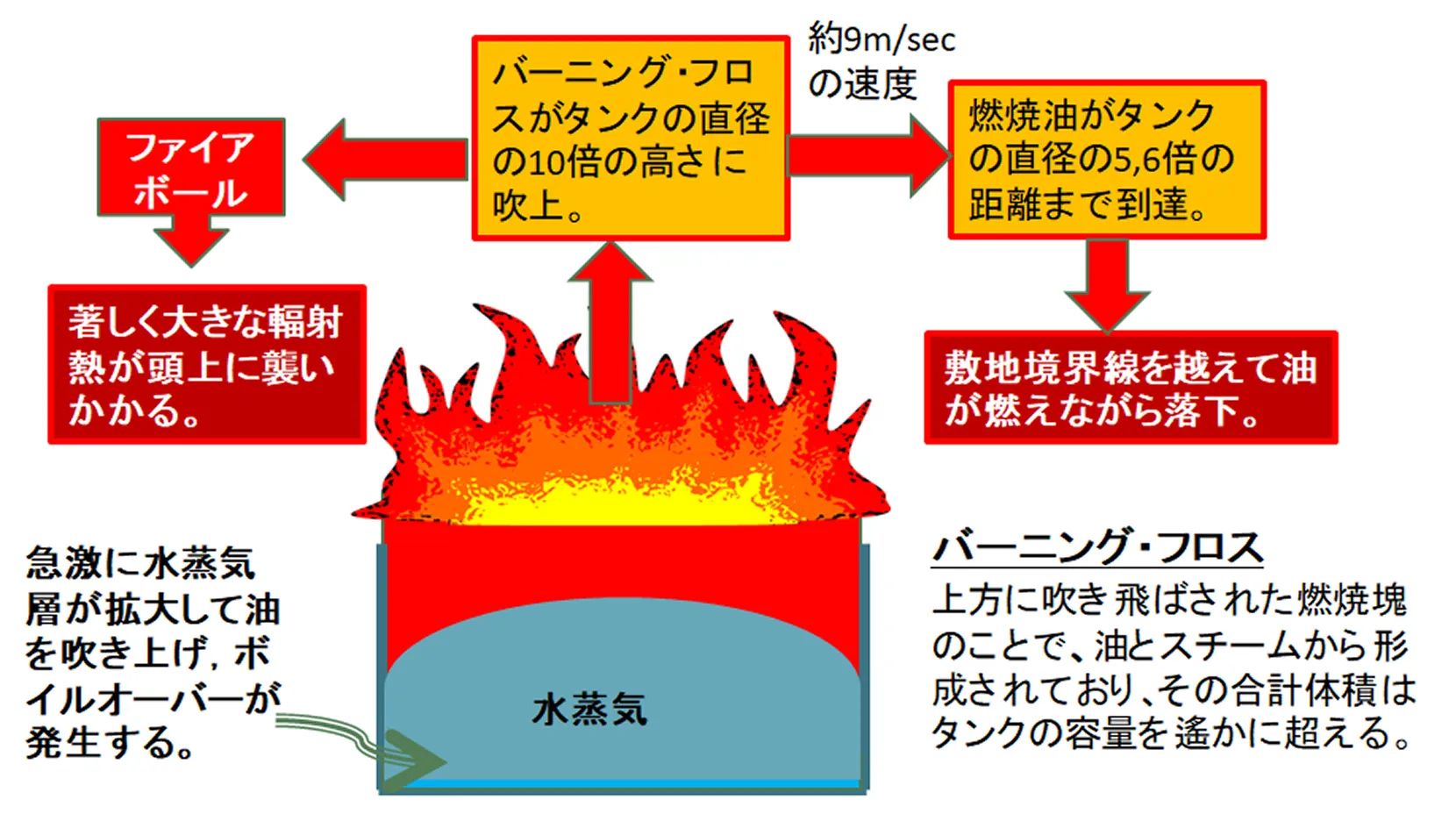
The hot oil that is ejected is called burning floss, which contains a lot of water vapor and can fly hundreds of meters, and it is even possible for burning oil to rain down from above, making it an extremely dangerous disaster.
Burning floss refers to the combustion mass that is blown upwards, and it is said that its total volume far exceeds the capacity of the tank.

Disasters that occur during a boilover
ボイルオーバー発生時の災害状況

Occurrence conditions

Various experimental results have shown that boilover can occur if the following conditions are met:

Conditions under which boilover occurs

  • A zone of constant temperature (hot zone or heat wave) occurs during a fire and expands downwards (this is due to the use of a multi-component fuel oil with a wide boiling point range).
  • Fuel oil has high viscosity. (It easily forms bubbles.)
  • The temperature in the hot zone must be 120°C or higher.
    (When hot oil comes into contact with the water layer at the bottom of a tank, if the temperature is 100°C, the water will boil, but the amount of steam generated is not large enough to lift the oil, and only the steam escapes as bubbles. However, at temperatures above 120°C, so-called nucleate boiling occurs, rapidly generating steam that spreads horizontally within the tank, lifting the entire oil and causing a boilover.)

Furthermore, boilovers are not limited to crude oil; they can occur with other flammable liquids (such as pure substances, gasoline, and heavy oil) if the above conditions are met. In fact, boilover accidents involving diesel fuel and heavy oil have occurred.
On the other hand, oils with a narrow boiling point range, such as diesel fuel and heavy oil, have a narrow high-temperature area below the combustion surface, and the temperature change follows an exponential curve. The downward movement speed of this high-temperature layer is also slow, which is the so-called combustion speed, so even if a boilover occurs, the amount of oil that is ejected is already small, making it less dangerous.

Relationship between hot zone temperature and growth rate

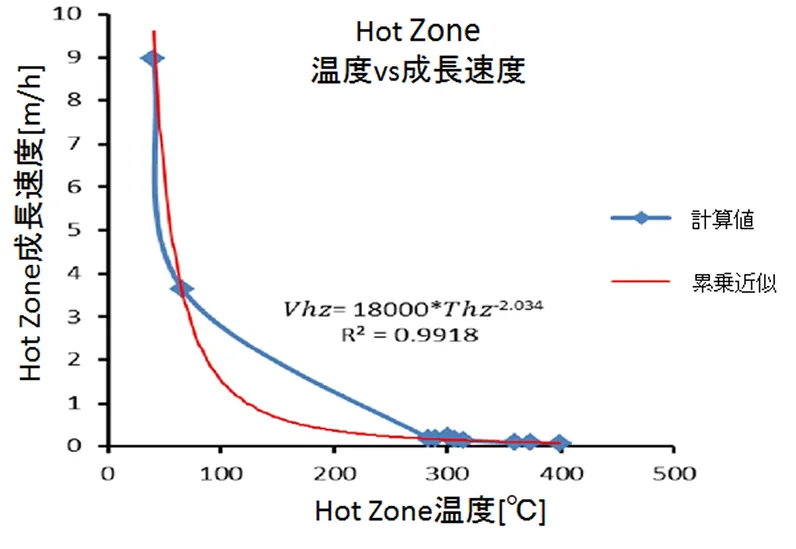
The graph on the right was obtained by performing calculations for various crude oils using this simulation program. Many studies have shown that experimental results indicate that the lower the temperature of the Hot Zone, the faster the growth rate, and this graph illustrates that well.
Furthermore, while the minimum temperature at which boilover occurs is said to be 120°C, this graph shows that the growth rate at 120°C is 1.06 [m/hr], which is consistent with LastFire's recommendation of a maximum growth rate of 1.0 [m/hr].

ホットゾーン温度と成長速度の関係グラフ

Boilover Simulation Examples

Case of a large tank with a diameter of 80m

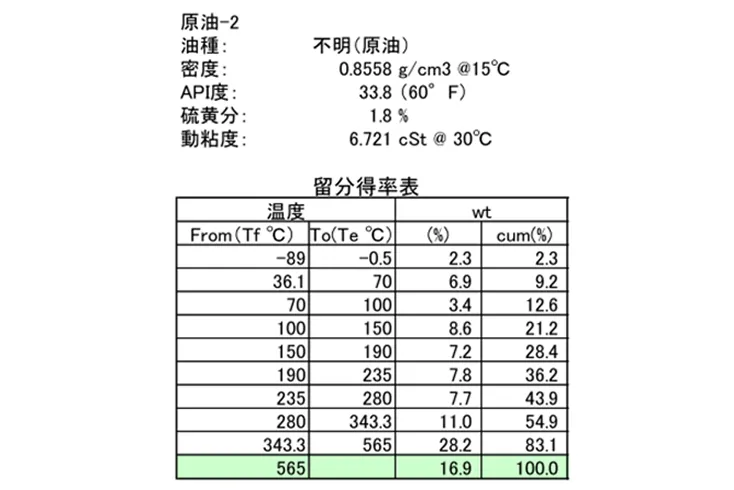
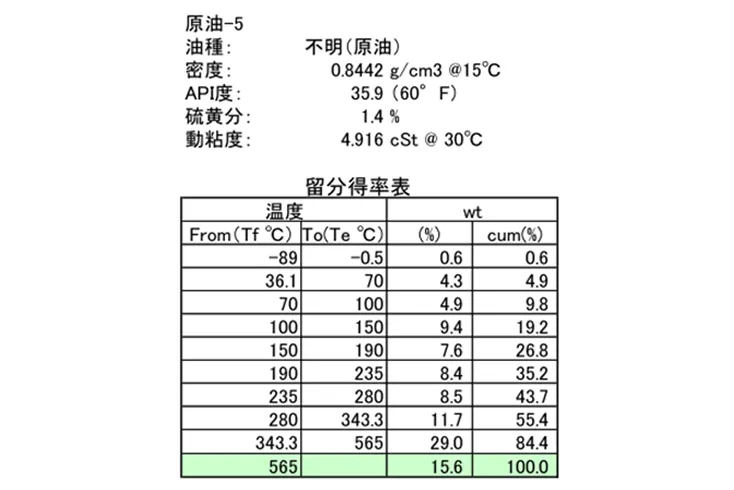
These are the results of calculations for two types of crude oil with different distillation curves. The calculation results showed that the time from fire outbreak to boilover was 1.8 days for crude oil-2 and 2.6 days for crude oil-5.
While it's common for hot zone temperatures to exceed 300°C, as in Crude Oil-5, there are also cases like Crude Oil-2 where a lower-temperature hot zone occurs initially, the process repeats from the beginning, and it's only on the third attempt that the hot zone temperature finally exceeds 120°C.

Distillation data (crude oil-2)

原油-2の蒸留データ

Calculation conditions and simulation results (Crude Oil - 2)

原油-2の計算条件とシミュレーション結果(拡大)

Distillation data (crude oil - 5)

原油-5の蒸留データ

Calculation conditions and simulation results (Crude oil - 5)

原油-5の計算条件とシミュレーション結果(拡大)

Oil temperature after extinguishing the fireAbout change

Conditions for Consideration

After the fire is extinguished, the upper part of the tank's liquid surface is a hot zone with a high temperature, while below that is a cooler oil layer at less than 120°C. The oil layer is in contact with the water layer, forming an interface.
The lower-temperature oil and water layers are heated by the oil above, but because the heating is from above, the temperature of the top of each layer rises first, and the density decreases, making convection unlikely. Therefore, each layer is heated by heat conduction. Since the rate of heat conduction is extremely slow compared to convection, it takes a long time for the temperature of each layer to rise.

Therefore, in our program, heat transfer within the oil reservoir and water tank was considered to be due to thermal conduction.

Simulation Examples

Case of a large tank with a diameter of 80m

In the case of natural cooling

With wind speeds of 6-8 m/sec, calculations showed that it would take 600 hours (25 days) after the fire was extinguished for the oil temperature to finally drop to approximately 140°C. As expected for a large tank, it takes nearly a month to cool the oil remaining inside after a fire, and sufficient disaster prevention measures must be considered during that time.

The effect of water spray cooling

Calculations showed that if water is continuously sprayed around the entire circumference of the tank, it can be cooled to approximately 125°C in 300 hours (12.5 days) after the fire is extinguished. The effect of spraying water is significant, and it can be cooled in about half the time compared to using wind.

If the fire is extinguished before a boilover occurs

Even if a fire is successfully extinguished before a boilover occurs, a hot zone has already formed. While the hot zone itself gradually cools, the temperature of the oil layer near the water layer gradually rises. Therefore, the possibility of a boilover remains even after the fire has been extinguished. Our program has shown that this possibility is small in large tanks, but in small containers such as drums, there is a possibility of a boilover occurring after the fire has been extinguished.

Contributed Literature

An article published in "The CATALYST January 2015"

Co-authored publication with Professor Hideo Otani of Yokohama National University.

Summary of the paper

Prediction of Hot Zone Temperature and its Extension Rate Up to Boilover
Hideo Ohtani, Professor, Department of Safety Management, Yokohama National University, Japan, and Yoshiyuki Kato, CEO of Corporation FPEC ,Japan,

Abstract
Simulation program was developed to predict hot zone temperature and its extension rate for a crude oil fire in a large tank. The calculated results are summarized in this report. Authors believe that these calculated results are reliable enough for an actual size tank fire, since the calculated results can well explain why around 1 [m/h] is the maximum hot zone extension rate in an actual tank fire as reported by LASTFIRE. Possibility of boilover and required time to cool down the hot oil after extinguishment of a crude oil tank fire were also studied by using another simulation program developed separately. In case of a large tank fire, it was found that possibility of boilover occurrence after extinguishment seems too little and so long days are required to cool the hot oil.

You can find more details about the paper at the following link.

Until boil-over
Prediction of hot zone temperature and its expansion rate