
Numerical analysis

overview

Our company also offers simulation services for explosions, fire spread, smoke generation and diffusion, and leaked gas diffusion using FDS and CFD solvers developed by NIST in the United States.

Our advantages in numerical analysis services

  1. Accurate modeling based on practical knowledge

    Our company possesses deep knowledge and extensive experience in disaster prevention and fire prevention systems for petrochemical plants, enabling us to accurately understand your request and reflect it in numerical analysis models.

  2. Technical dialogue using engineering terminology

    We will avoid using specialized terminology specific to numerical analysis and instead use engineering terms commonly used in petrochemical plants during our meeting.

  3. Analysis Guidelines for Explosions and Dispersions in Indoor Environments

    For indoor gas diffusion and explosions, there is no method other than numerical analysis simulation, and we propose problem-solving by combining this with our proprietary leak and evaporation simulations.

  4. Proposal of the optimal method according to the target

    Numerical analysis is suitable for localized diffusion, even outdoors. We will propose the appropriate method on a case-by-case basis.

  5. Visualization of analysis results

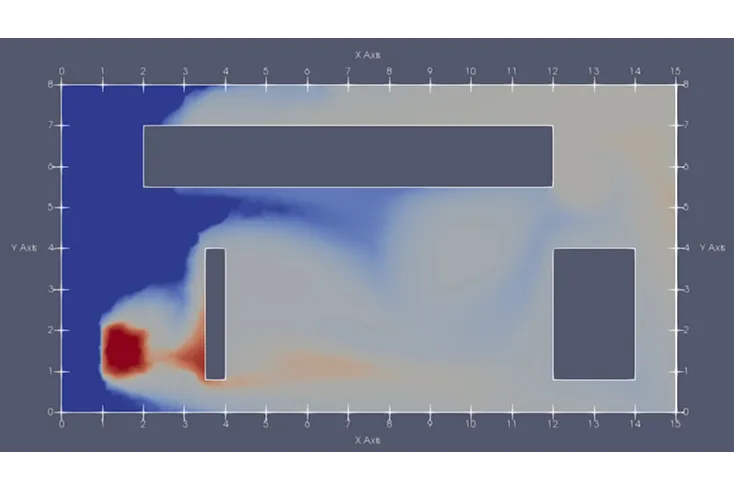
    Numerical analysis results will be presented not only in standard outputs such as videos and gradient maps, but also in formats that make it easy to interpret the results, such as density maps.

  6. Technical collaboration system with external organizations

    We have received technical cooperation from Computational Fluid Dynamics Research Institute Co., Ltd. and Advance Soft Co., Ltd. for the numerical analysis calculations.

Leakage, evaporation, and diffusion

Analysis example

From the atmospheric ventGas emission and diffusion

When the main valve is opened, gas flows through the empty piping, expanding as it reaches the nozzle, undergoing changes in pressure and temperature, and finally being released into the atmosphere as a stable jet, where it diffuses. The series of calculations up to the point of reaching the nozzle involves determining the jet velocity, temperature, and density using a thermodynamic/engineering approach, and then performing diffusion calculations using numerical analysis methods based on that data. In most cases, the jet velocity is greater than the speed of sound, so the ejection velocity has a significant impact on diffusion.

The gradient density map is a result diagram obtained from numerical analysis.
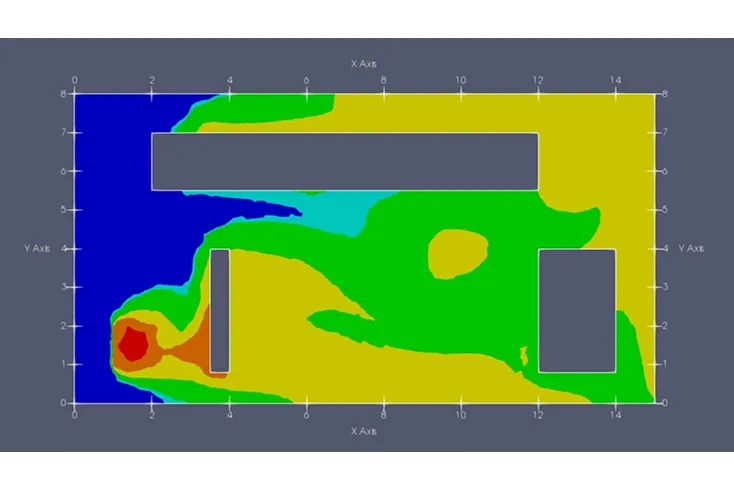
On the other hand, our company creates contour plots (isoline plots: points with the same value are connected by lines, and the areas between them are color-coded) based on the calculation results obtained from numerical analysis. Compared to gradient density maps, the boundaries and ranges of density are extremely clear, and we believe that this is very effective for subsequent analysis and consideration.

Example of individual risk assessment results

大気ベントからのガス噴出と拡散 個別リスク評価結果例

Examples of individual risk assessment results and physical property data

大気ベントからのガス噴出と拡散 個別リスク評価結果例・物性データ