
Conventional
Latest setup method

Conventional explosion-proof area setting method

Traditionally, explosion-proof areas were to be defined in accordance with the "Guide to Explosion-Proof Equipment for Factory Users," a technical guideline from the National Institute of Occupational Safety and Health. However, it is becoming increasingly common to define them according to local government standards, such as the Yokkaichi City Hazardous Materials Regulation Review Standards, which are more specific and clearly defined.
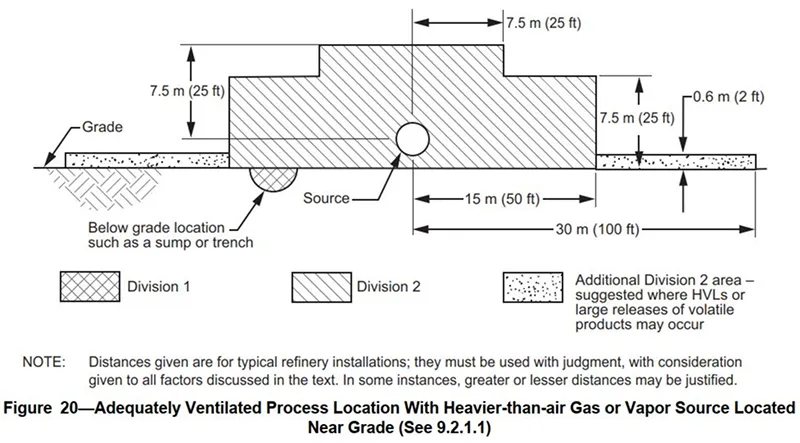
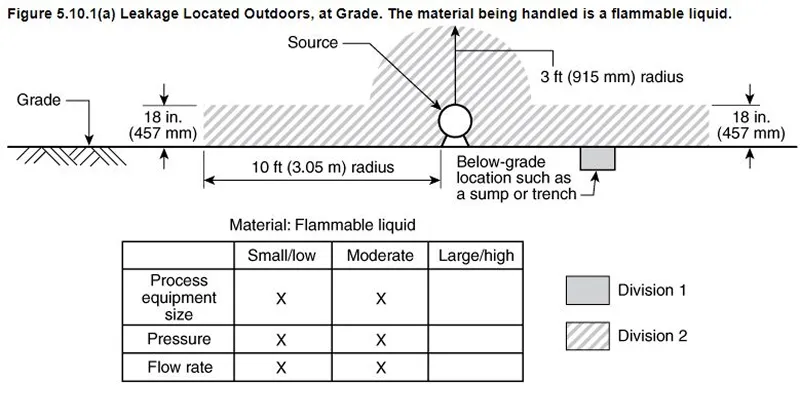
These standards are based on API RP500 or 505 (American Petroleum Institute) and NFPA 497 (National Fire Protection Association), and as shown in the sample diagram below, they uniformly designate explosion-proof areas for any flammable hazardous material, regardless of its vapor pressure, molecular weight, or potential for leakage.

API RP500のサンプル図
NFPA497のサンプル図

Latest configuration methods (explosion-proof guidelines and IEC Ed3.0)

The "Guidelines for the Precise Determination of Hazardous Areas within Plants" (Explosion Protection Guidelines) and "IEC 60079-10-1 Edition 3.0" (IEC Ed3.0) present criteria for assessing risk (suggestive values such as the size of the leak opening and the degree of ventilation), and the method has shifted to assessing risk on a case-by-case basis by quantifying the amount of leakage and the degree of diffusion.

Recent Trends in Explosion-Proof Area Setting Criteria

2015
IEC 60079-10-1 Edition 2.0 (IEC Ed2.0) has been published. This enables the precise designation of hazardous areas based on quantitative risk assessment.
2019
The Ministry of Economy, Trade and Industry has issued explosion-proof guidelines based on IEC Ed2.0. The Fire and Disaster Management Agency has issued Fire and Disaster Management Agency Notice No. 84, "Regarding the operation of areas where flammable vapors may remain in hazardous materials facilities," to all prefectural fire departments.
2020
The latest version, IEC Ed3.0, has been published. (IEC Ed2.0 is now invalid.)
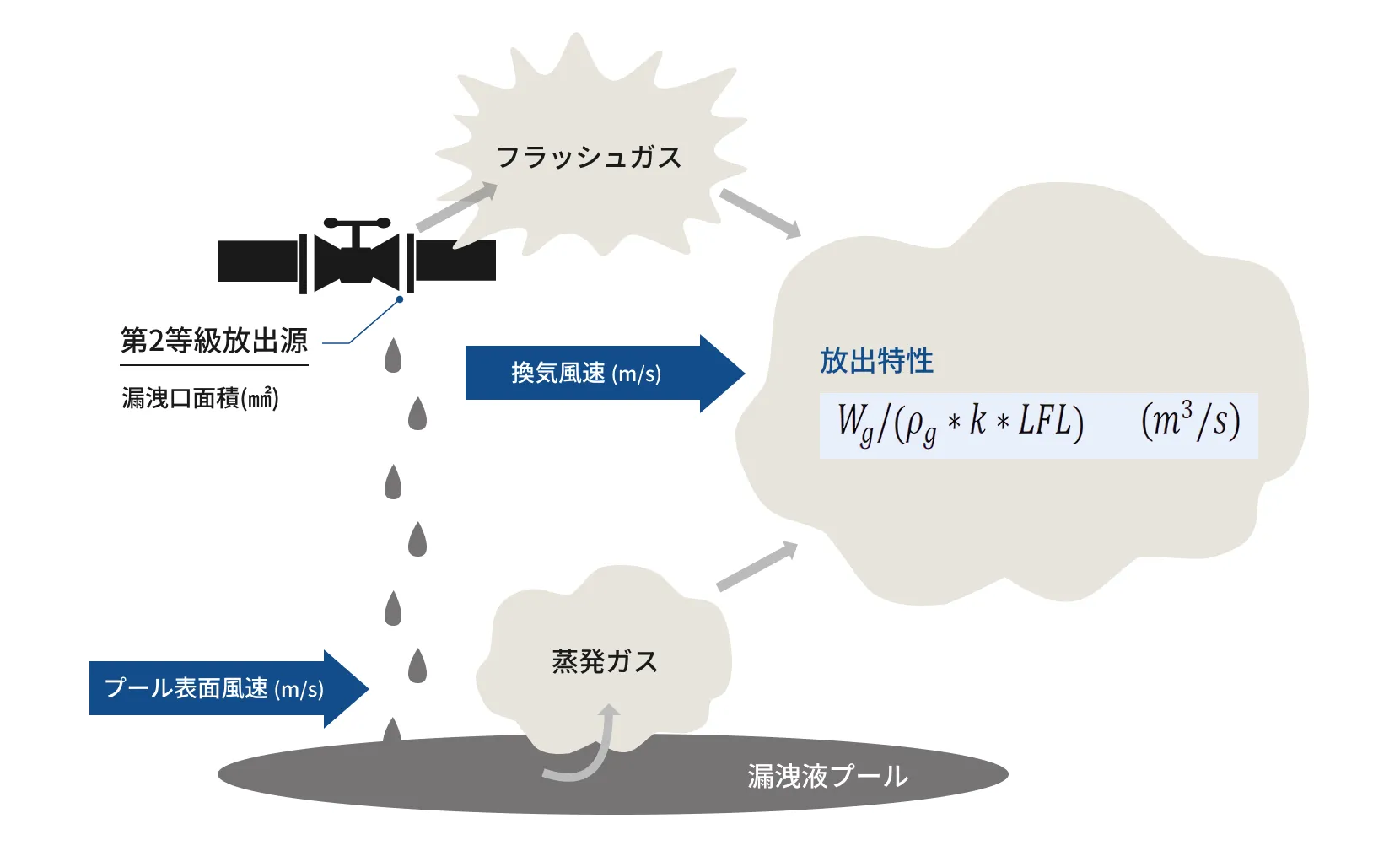
A conceptual diagram of a precise risk assessment.
精緻なリスク評価の概念図

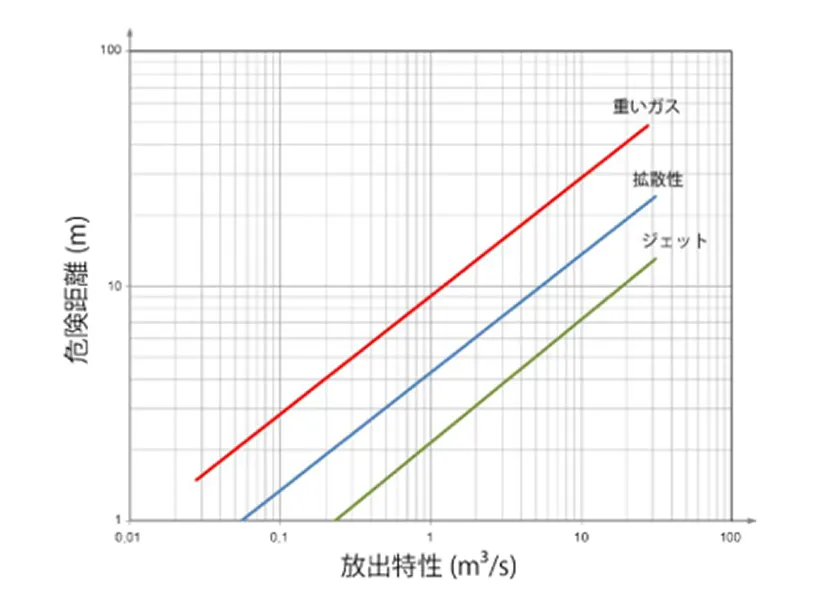
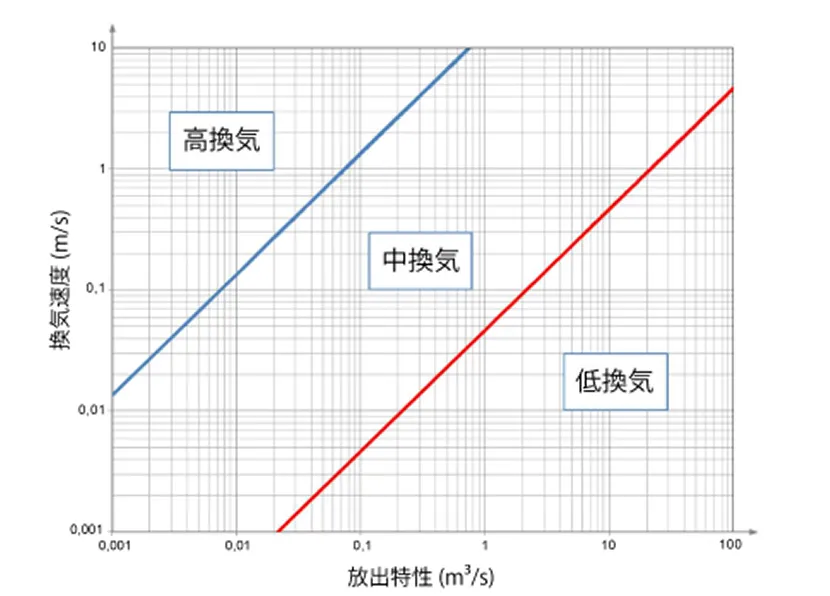
Based on the risk assessment of each individual case, it became possible to determine whether an area is a hazardous or non-hazardous area, and as a result, the area of non-hazardous zones often became larger. If an area is determined to be a hazardous zone, its extent (hazardous distance) can also be read from the graph.

Ventilation

換気度グラフ

Dangerous distance

危険距離グラフ

Source: Ministry of Economy, Trade and Industry, "Guidelines on Precise Methods for Determining Hazardous Areas within Plants" (January 2020)

Differences in hazardous areas between conventional and the latest setting methods

Outdoor facilities

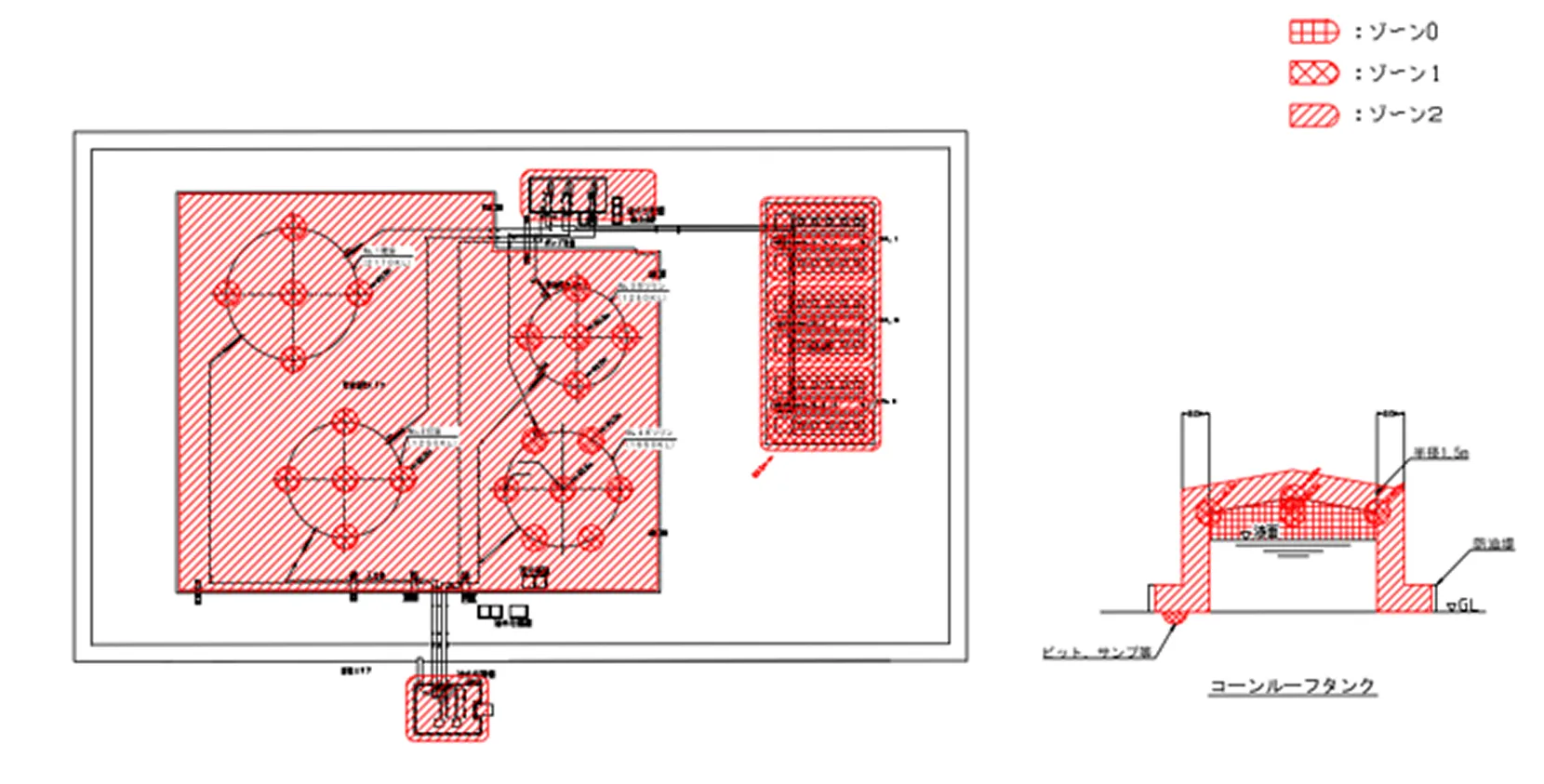
Traditionally, hazardous areas were designated almost uniformly for flammable materials, regardless of their vapor pressure, molecular weight, or potential for leakage. Therefore, the entire area containing plant equipment was almost always designated as a hazardous area.
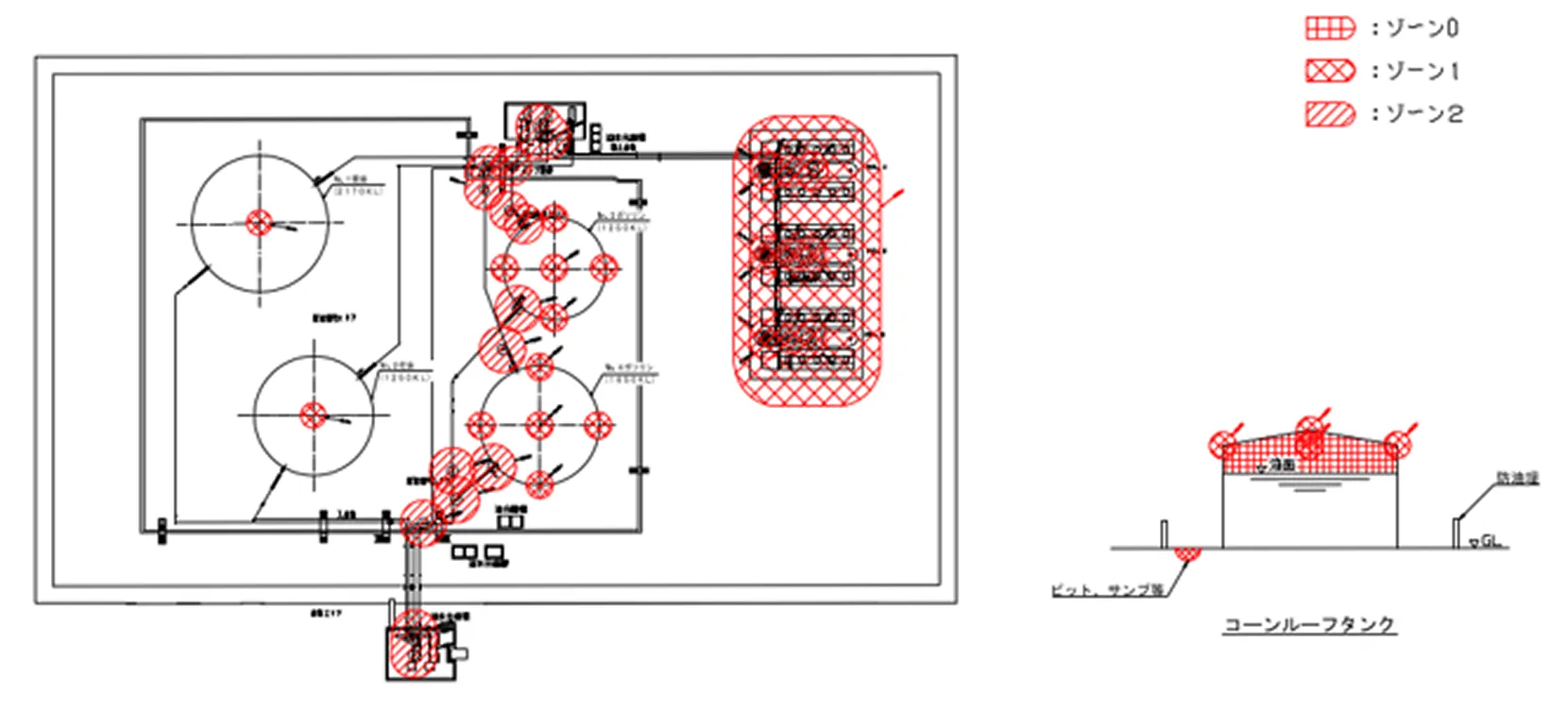
On the other hand, the latest configuration method allows for a precise risk assessment of each individual case, making it possible to determine whether an area is a hazardous or non-hazardous area, and as a result, the non-hazardous area is often larger.

Conventional hazard zone map

従来の危険区域図

Hazardous area map using the latest configuration method

最新の設定方法による危険区域図

Comparison of hazard zone maps using conventional and the latest setting methods.

  • In vents designated as Class 1 emission sources, hazardous areas remain due to highly volatile substances (such as gasoline in the diagram above), but if kerosene or diesel fuel is used, the hazardous areas disappear in some vents.
  • In a Class II release source, the area around valves, pumps, and other components of the gasoline pipeline becomes a hazard zone, but the spill is contained within a hazardous distance, and the entire containment dike does not become a hazard zone. A large area of non-hazard zone is secured.
  • While there are still hazardous areas at the tanker truck loading area and piers, these areas have been reduced compared to the previous designation method.

Indoor facilities

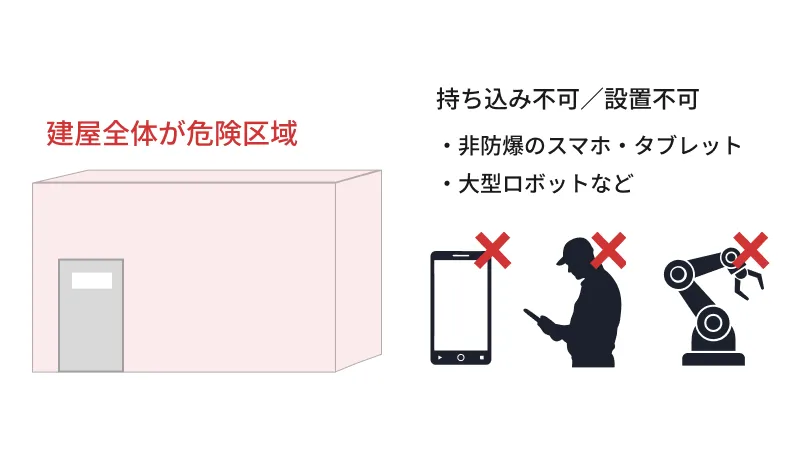
Conventional setup method

屋内施設 従来の設定方法

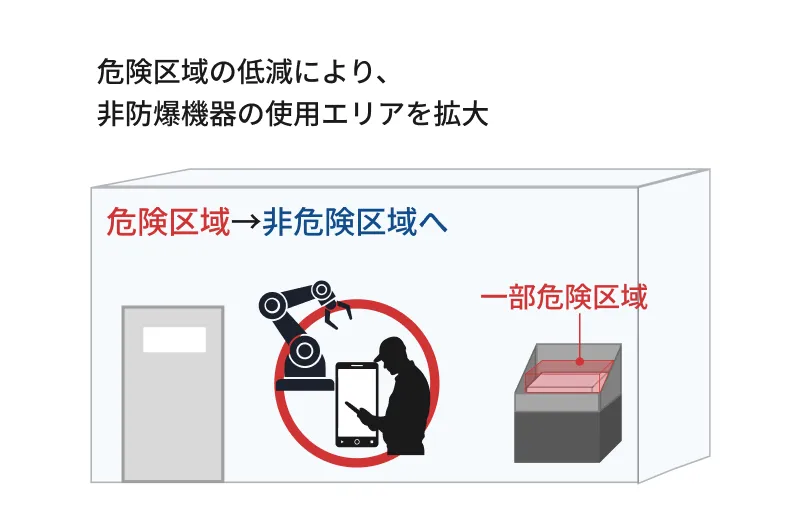
Previously, hazard zones were designated almost uniformly, similar to outdoor areas, meaning the entire facility was considered a hazard zone. As a result, non-explosion-proof smartphones and tablets could not be brought in, and the installation of large robots and other equipment was prohibited.

Latest setup method

リスク評価後
01 After risk assessment

Similar to outdoor environments, conducting a detailed risk assessment for each individual case often resulted in a wider area of non-hazardous zones.

換気見直し
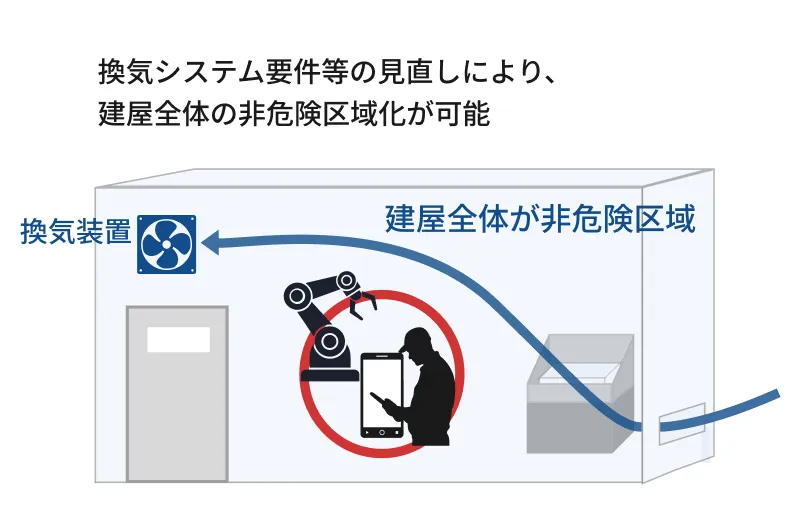
02 Review of ventilation (entire indoor area)

Unlike outdoors, indoor spaces have ventilation systems, making it possible to enhance their capacity and increase the ventilation rate. This reduces the remaining hazardous areas and even makes the entire indoor space a non-hazardous area.

局所排気の設置
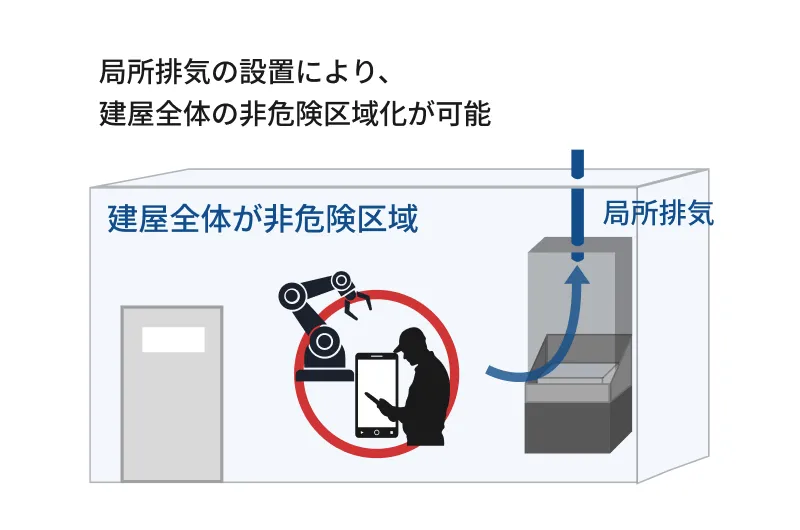
03 Review of ventilation (installation of local exhaust ventilation)

If the hazardous area is localized, it is possible to install local exhaust ventilation systems around the hazardous area to increase the ventilation rate locally and turn it into a non-hazardous area.

Examples of designating an area as non-hazardous

Recently, we have been receiving a great many inquiries not only about redefining or reducing hazardous areas, but also about designating areas as non-hazardous.

Case Studies | Examples of Designating Areas as Non-Hazardous

  • Indoors, it is entirely possible to designate the entire area as a non-hazardous zone by reviewing the requirements for the exhaust system (including its use in conjunction with local exhaust systems), such as increasing ventilation capacity and providing redundancy.
  • Because calculations are performed based on physical property data, depending on the fluid being handled, in some cases, most of the area may be considered a non-hazardous zone.
  • In conventional designs, the entire area within an oil containment dike at oil depots and refueling facilities is considered a hazardous zone. However, in some cases, most of the area within the dike, excluding the areas around flanges, valves, pumps, vents, and pit sections, is considered a non-hazardous zone.
  • By using equipment that prevents leaks, such as canned pumps and bellows-type valves, it is possible to designate an area as a non-hazardous zone.