
Firefighting water main networkHealth assessment

overview

With the revision of the Petroleum Disaster Prevention Act, a review of existing fire extinguishing systems is urgently needed. Based on the drawing information, our company will carefully examine the calculation conditions and then use specialized hydraulic calculation software to precisely verify everything from updating the drawings to load concentration and shut-off operation risks when pumps with different characteristics are operated in parallel, and increased pressure loss due to aging deterioration.
Furthermore, we propose a comprehensive review and consideration of maintaining water supply functionality in the event of pipe rupture, as required by legal regulations, including optimization of block valves and pressure resistance measures.

reference

Partial revision of the implementation method for periodic inspections of designated disaster prevention facilities, etc. (April 18, 2014)

For outdoor water supply facilities for firefighting that have been in place for 40 years or more, the following new inspections will be required:

  1. Verify whether the pressure pump meets the rated performance specifications.
  2. At the fire hydrant where the pressure loss from the booster pump is greatest, water is discharged to confirm whether the discharge pressure and water volume are appropriate.
  3. When a water pressure equal to the shut-off pressure of the booster pump is applied to the piping, check for deformation, damage, or leaks.

Please refer to the following link for the full text of the revised notification.

When to consider our services

Case 01

Unorganized and unupdated drawings

A long time has passed since construction, and the drawings have not been updated each time piping has been extended due to expansion.

Solution

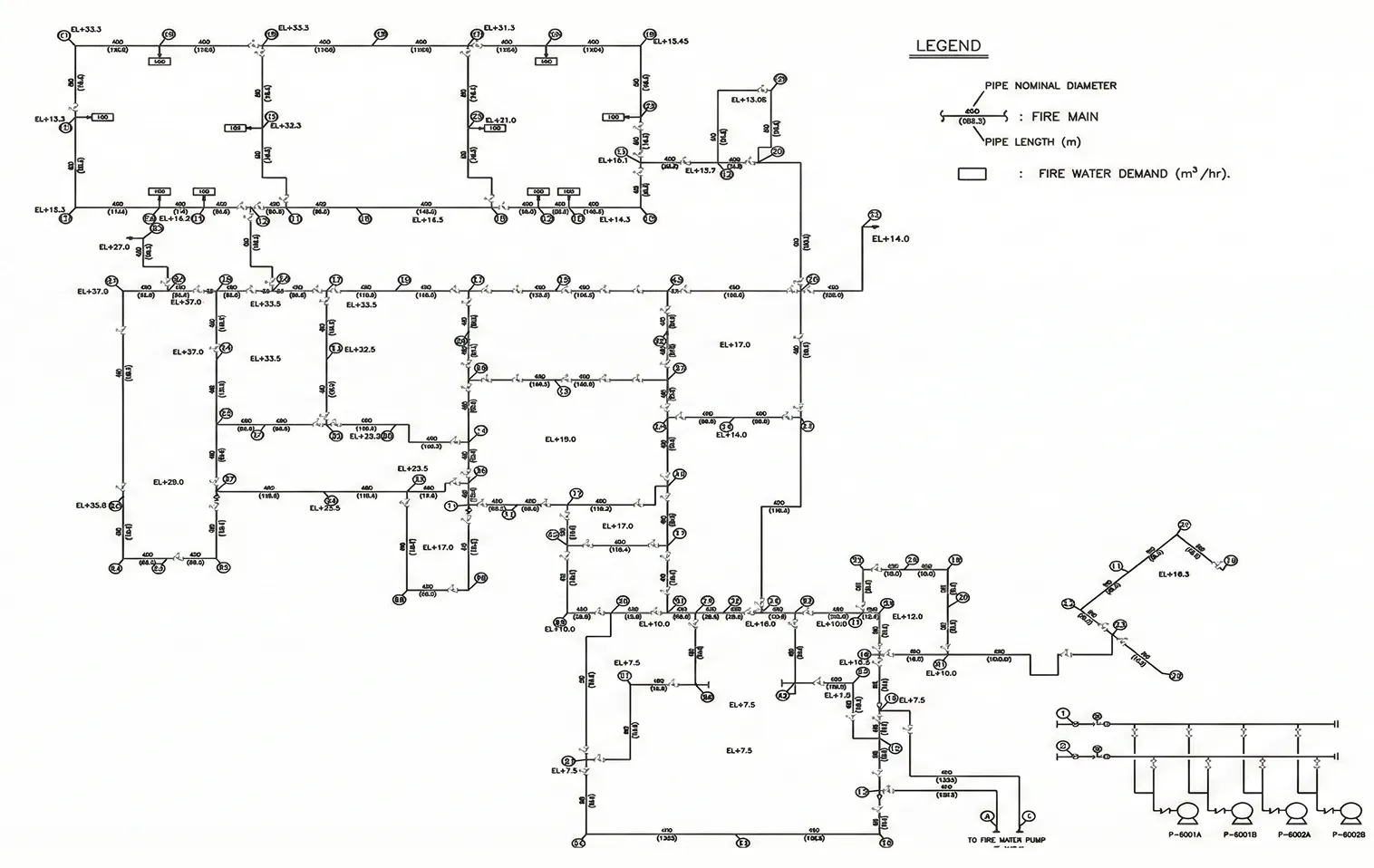
Creation or updating of the overall layout diagram of the fire-fighting water main pipeline network.

Based on information such as piping diagrams for expansions in each area, we will compile a comprehensive layout diagram of the main fire-fighting water pipeline network.

Case 02

Addition of fire pumps

Due to the expansion, pumps are scattered throughout the facility, and the simultaneous operation of pumps with different heads and types (vertical and horizontal) could lead to a risk of load concentration on specific pumps (overrunning) or shut-off operation on the lower head side.

Solution

Checking for any problems when fire pumps are operating in parallel.

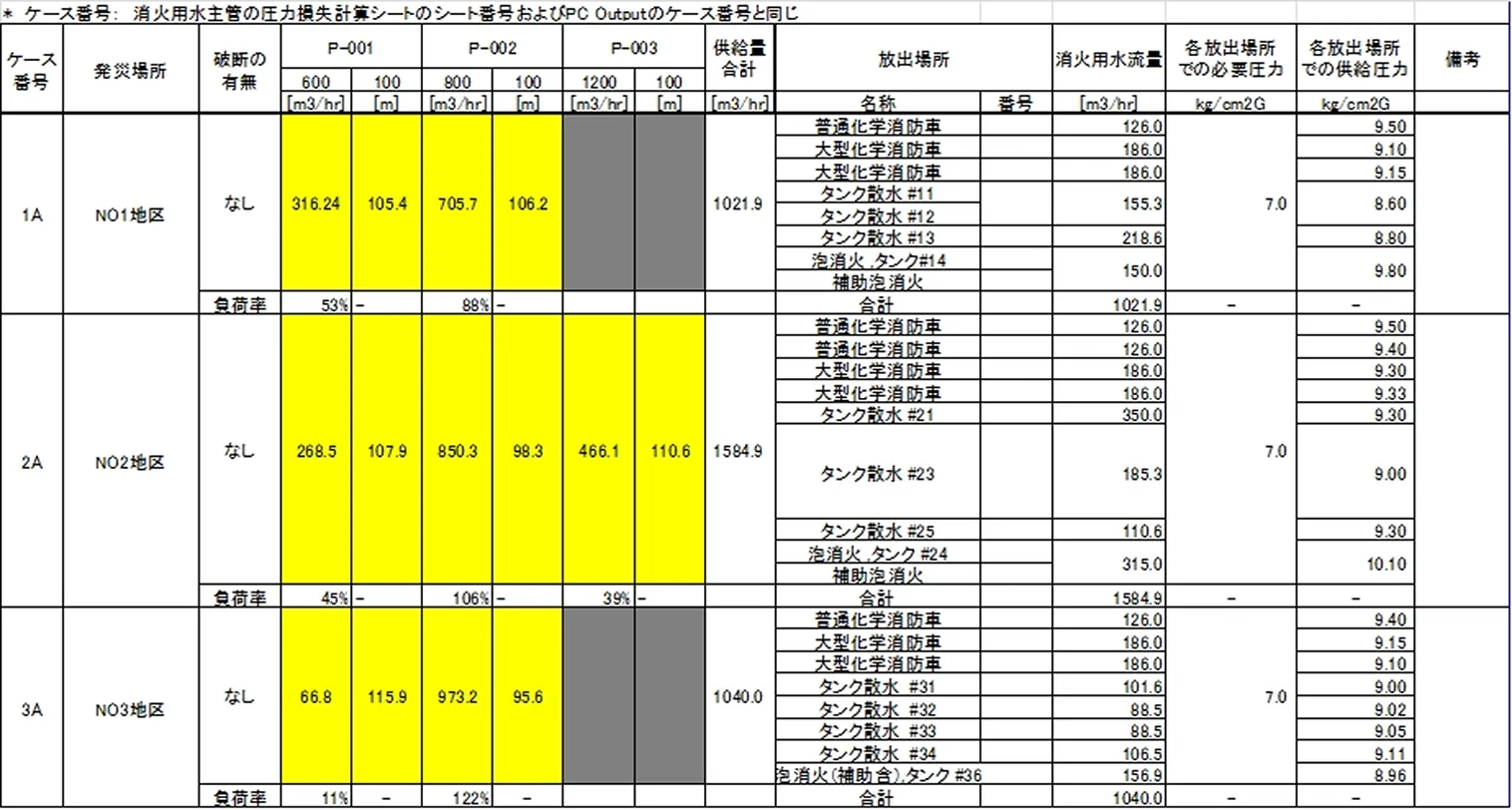
After determining the load factor for each pump through hydraulic calculations, we formulate optimal countermeasures to avoid problems such as overrunning due to mismatched heads and shut-off operation.

Case 03

Deterioration of the main water supply network for firefighting due to aging

A long time has passed since construction, and problems such as corrosion and blockage of existing pipes have arisen.

Solution

Pressure loss calculation and countermeasures

We incorporate the changes over time based on NFPA statistics into hydraulic calculations as the C-value in the Hasen-William formula, identify piping sections where increased pressure loss is a problem, and then formulate optimal countermeasures.

Examples of business operations

01

Based on existing drawings and on-site surveys, a complete layout diagram of the fire-fighting water main pipeline network, including block valves, was created and updated.

ブロックバルブを含めた消火用水主管網の全体配置図
02

Setting the C value in the Hasen-William formula (pressure loss calculation formula)

  • Estimation of C value due to changes over time
  • Estimation of C value after pig cleaning
03

Perform fire extinguishing piping network calculations based on the required flow rate and pressure for each fire area.

  • Pipe mesh before cleaning and modification
  • After pig cleaning, the pipe grid before modification.
  • After pig cleaning, the modified pipe network.
  • In accordance with the requirements of the Stone Disaster Prevention Act, calculations for the pipe network in the event of a single rupture.
    (It is necessary to confirm that sufficient pressure can be maintained even when the rupture point is blocked by operating the block valve.)
04

Consideration of parallel operation of fire pumps

  • The above calculation of the pipe network involves connecting multiple fire pumps and calculating the load factor of each pump.
  • When a specific fire pump is under load exceeding 150%, the pipe network is recalculated by inserting a limiting orifice.
05

Summary of the findings

検討結果のまとめ
06

Drafting a plan to modify the main water supply network for firefighting.

  • Improvement of smoothness of pipe inner surface by pig cleaning
  • The addition of a block valve ensures an alternative route in case of pipe damage.
  • Upsizing some pipes
  • Partial addition to the piping route
  • Solutions to the problem of parallel operation of fire pumps
    ① Install a restricting orifice in the discharge of the fire pump.
    ② Installation of a fire pump discharge pressure control valve

Used in pipe network calculationssoftware

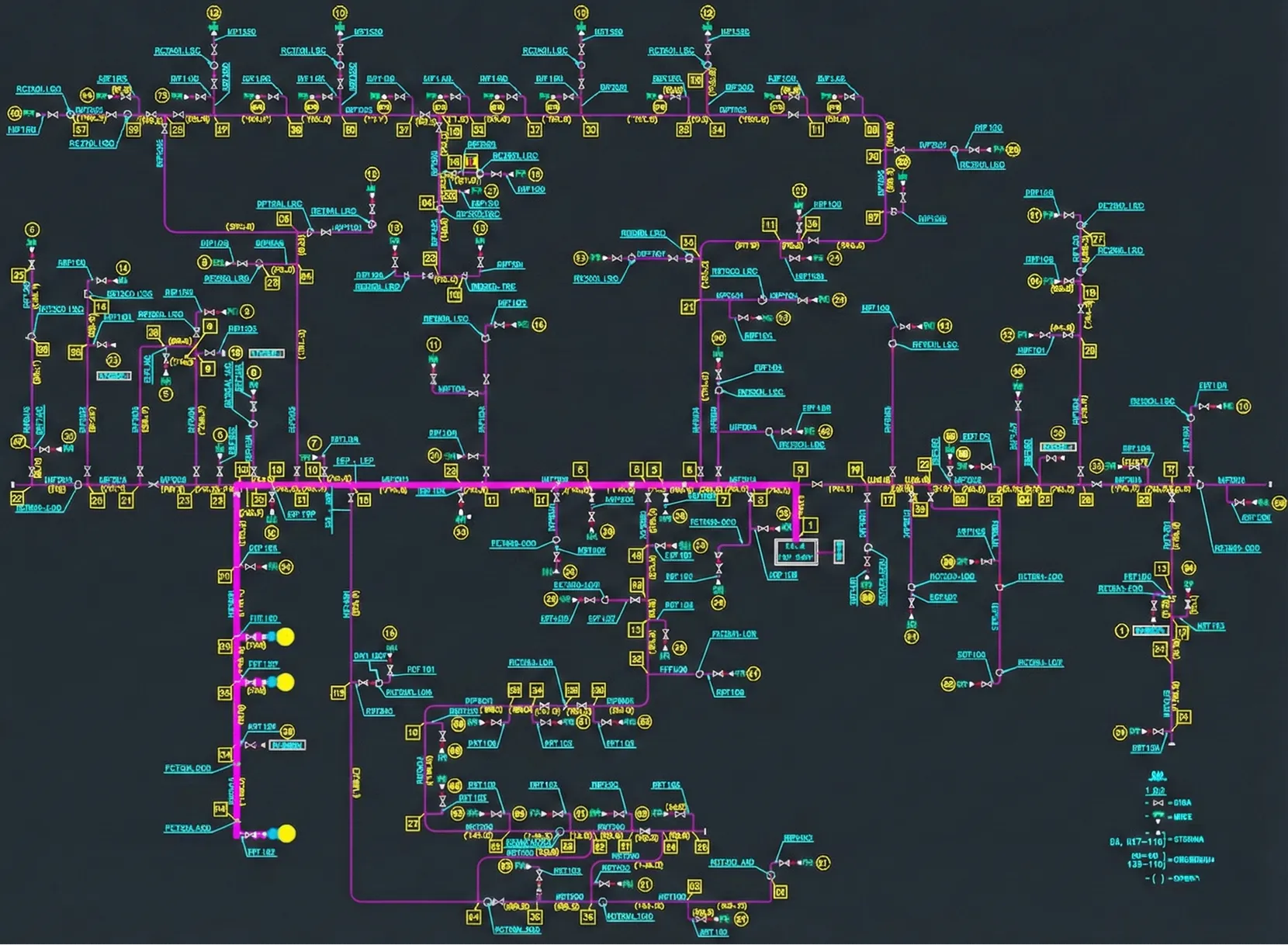
Pressure loss calculations for fire extinguishing water main networks, sprinkler piping, and other systems are performed using Sunrise's "Pipenet" software, which is also used by major oil companies. Even complex piping systems, as shown in the diagram below, can be calculated.
Furthermore, multiple fire pumps can be connected, and the performance curves of each pump can be input as data, allowing for consideration of the feasibility and potential problems of parallel operation of fire pumps.

catalog

You can view our catalog for fire extinguishing piping hydraulic calculations and structural integrity assessments here.

消火用水主管網見直しのカタログ